
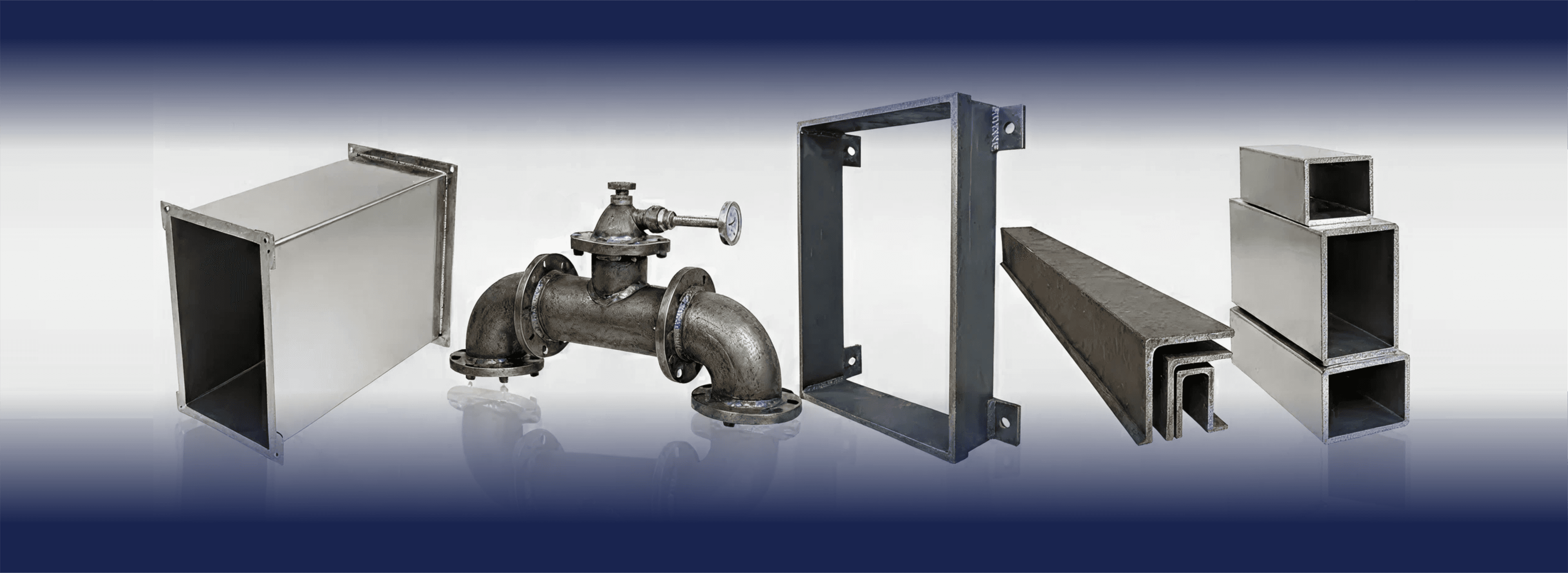
DUCT FABRICATION VS PIPE SPOOL FABRICATION
Duct fabrication produces sheet metal air-distribution systems built to SMACNA. Pipe spool fabrication produces welded pipe assemblies for fluid or gas service built to ASME B31 and the project's process specification. Same shop, very different engineering paths, weld procedures, inspection requirements, and documentation packages.
The shorter answer for buyers trying to scope which one a project actually needs: if it's moving conditioned air, it's duct. If it's moving water, steam, hydrocarbons, or process fluids under pressure, it's pipe spool. Most large mechanical projects need both, and the two scopes run on parallel tracks inside JMC.
Published May 19, 2026 · JMC Fabrication
The cleanest way to tell the two apart is by what's flowing through them. Duct carries air at low pressure for HVAC, ventilation, and exhaust. Pipe spools carry fluid or gas at process pressure for plumbing, mechanical, oil and gas, marine systems, and industrial process work. That single distinction drives everything downstream: the geometry, the wall section, the code path, the joining method, the inspection requirements, and the documentation that follows it.
A rectangular galvanized trunk at 4 inches of water column is duct. A schedule 80 carbon steel pipe spool at 600 psi is a process pipe. Both can be on the same building. Both get fabricated by JMC. But they don't share procedures, inspection plans, or paperwork.
Understanding the split matters at the quote stage, because conflating them creates underestimated scope. A 'duct package' for a process plant might actually have pipe spool scope hidden inside it (instrument air lines, drain lines, condensate runs) that need to be quoted separately under the right code path.
Here's where duct and pipe spool work part ways inside a fabrication shop:
- Material and wall section: Duct is sheet metal: galvanized, stainless, or specialty alloy at gauges (16ga, 18ga, 20ga, 22ga) selected per SMACNA pressure class. Pipe spool is pipe: A53 or A106 carbon steel, 304 or 316 stainless, or other alloys at wall schedules (schedule 10, 40, 80, XS, XXS) selected per ASME B31 pressure rating. Sheet versus schedule is the first physical difference.
- Code path: Duct follows SMACNA construction standards, with pressure class and seal class drawn from the mechanical specification. Pipe spool follows ASME B31 (B31.1 for power piping, B31.3 for process piping, B31.4 for liquid pipelines, B31.9 for building services), plus any additional industry specs (NAVSEA for naval work, API for upstream oil & gas, AWWA for water). Different code, different qualification requirements.
- Joining method: Duct joins through mechanical seams (Pittsburgh lock, snap-lock, S-cleat, drive cleat) and connection systems (TDC/TDF, slip joints, flanged) per SMACNA. Welded duct exists for specialty stainless and chemical exhaust scopes, but the bulk of commercial duct is mechanically seamed. Pipe spool joins through welding, with the WPS selected for the material, the welder qualified to the procedure, and every joint logged.
- Inspection: Duct inspection focuses on construction (seam integrity, gauge compliance, fit-up to drawings) and leakage class where the spec calls for it. Pipe spool inspection runs the full NDE suite the project requires: visual (VT), penetrant (PT), magnetic particle (MT), radiographic (RT), ultrasonic (UT). Each weld can have a pass/fail record. Duct doesn't carry that kind of weld-by-weld documentation because most joints aren't welds.
- Documentation: Duct closeout includes mill certs for gauge material, SMACNA class records, and any specialty material MTRs. Pipe spool closeout includes MTRs for every heat, weld logs identifying each weld and the welder, NDE reports per the project plan, pressure test records, and full traceability from drawing to material to weld to inspection. The pipe spool closeout package is typically much heavier paper.
On the engineering side, duct and pipe spool work move through JMC on parallel tracks with different deliverables. Duct engineering takes the mechanical engineer's design (in Revit, AutoCAD, or 2D drawings), details the duct to SMACNA construction, produces shop drawings, and generates a bill of material organized by fitting type and gauge. The shop drawing is the primary deliverable.
Pipe spool engineering takes the customer's P&ID and isometric drawings (or builds them from inputs), produces spool drawings with each spool numbered and dimensioned, generates weld maps that identify every joint, and ties each weld back to a WPS in the procedure library. The spool drawing plus the weld map plus the bill of material is the deliverable, and every line item traces back to the isometric.
Both workflows use AutoCAD and Revit on the front end. Both produce shop-ready documentation. But the documents themselves look different because the downstream production is different. A duct shop drawing tells the brake operator what to fold. A pipe spool drawing tells the fitter what to tack and the welder which procedure to run.
Side-by-side comparison of how the two scopes differ across the dimensions that matter to a project planner:
| Dimension | Duct Fabrication | Pipe Spool Fabrication |
|---|---|---|
| What it carries | Air (HVAC, ventilation, exhaust) | Fluid or gas under pressure |
| Material | Sheet metal (galvanized, stainless, specialty) | Schedule pipe (carbon, stainless, alloy) |
| Code path | SMACNA construction standards | ASME B31.1/B31.3/B31.4/B31.9, plus industry specs |
| Joining | Mechanical seams (Pittsburgh, snap-lock, TDC/TDF) | Welded joints with qualified WPS |
| Inspection | Visual, construction, leakage class | VT, PT, MT, RT, UT per project NDE plan |
| Documentation | Mill certs, SMACNA class records | MTRs, weld logs, NDE reports, pressure tests |
| Primary drawing | Shop drawing with seam and fitting detail | Spool drawing with weld map and BOM |
| Welder cert path | Not required for mechanically seamed duct | AWS, NAVSEA, ASME IX per project |
Large mechanical projects routinely have both scopes. A commercial building has HVAC duct everywhere overhead and pipe spools in the mechanical room for chilled water, hot water, condensate, and natural gas. A process facility has process pipe spools tying equipment together and exhaust duct pulling fumes out. A marine refit has both, often in tight overhead spaces where coordination between duct and pipe is the install schedule's biggest risk.
JMC handles both under one roof, which removes a common project risk: misaligned schedules between a duct shop and a pipe shop. When the duct fabricator and the pipe fabricator are separate vendors, coordination meetings, drawing exchanges, and clash resolution slow down. When both scopes run inside one engineering room, one shop floor, and one PM's project plan, the coordination shrinks to a shared model and a shared schedule.
On the documentation side, JMC produces separate closeout packages per scope (because the code paths require it) but ties them together at the project level. The customer gets a duct package with mill certs and SMACNA records, a pipe spool package with MTRs and NDE reports, and a project-level index showing how the two relate.
If you're scoping a new project and not sure which side of the line a given run falls on, here's the quick read:
- Moving conditioned or ventilation air at low pressure → duct fabrication
- Moving exhaust, dust collection, or fume hood air → typically duct, though heavy chemical exhaust may use welded stainless
- Moving any fluid (water, glycol, oil, condensate) → pipe spool
- Moving gas under pressure (natural gas, instrument air, process gas) → pipe spool
- Moving steam → pipe spool, almost always under ASME B31.1
- Code reference says SMACNA → duct
- Code reference says ASME B31, ANSI, API, or NAVSEA piping spec → pipe spool
- Drawing format is a sheet metal layout → duct; drawing format is an isometric → pipe spool
Can the same shop fabricate both, or do they usually split?
Some shops specialize in one or the other. JMC runs both under one roof, with separate engineering workflows, separate WPS libraries for pipe versus duct welding, and separate closeout document templates. The advantage of one shop handling both is that coordination across the two scopes happens internally on a shared schedule instead of through vendor-to-vendor meetings.
Is welded duct the same as pipe spool work?
No, even when both are welded. Welded duct (typically stainless for chemical exhaust or specialty scopes) follows SMACNA construction with seam welds, and the inspection focuses on leakage class and construction integrity. Pipe spool welds follow ASME B31 or a related piping code with qualified WPS, welder cert tied to the procedure, and full NDE per the project plan. Different code, different documentation, different welder qualification path.
What does NDE on pipe spools usually include?
It depends on the project's NDE plan. The common methods are visual inspection (VT) on every weld, penetrant testing (PT) on specified joints, magnetic particle (MT) on ferromagnetic materials where surface flaws matter, radiographic testing (RT) for volumetric inspection on critical pressure joints, and ultrasonic (UT) where RT isn't practical. The project spec dictates which methods at what percentage of welds.
Does duct ever need MTRs?
Mill certs are standard for galvanized and stainless duct material and are included by default on projects where the spec calls for them. Full MTR-level traceability (heat-by-heat tied to specific duct sections) isn't the norm for commercial HVAC duct but can be required on specialty scopes (clean rooms, hospital, lab, marine). The project specification drives it.
Why does pipe spool work have a heavier documentation package?
Because the failure consequences are different. A duct leak loses conditioned air. A pipe leak under pressure loses fluid or gas, sometimes in dangerous or expensive ways. The pressure piping codes require traceability from the mill through the weld through the inspection so that any future investigation can reconstruct exactly what was installed. That's why the spool closeout package includes MTRs, weld logs, NDE reports, and pressure tests, and why every weld can be tied back to a welder and a procedure.
If we send JMC a single drawing set with both duct and pipe, how does the quote come back?
JMC's engineering team splits the scope at quote stage: duct work gets a SMACNA-based quote with gauge and class breakdown, pipe spool work gets an ASME-based quote with material schedule, welding, and NDE breakdown. The customer sees both as part of one project quote but with the right code path and documentation requirements priced into each side.
Which one usually drives schedule on a mixed project?
Pipe spool work usually drives schedule. The welding, NDE, and pressure testing on pipe spools have lead-time floors that duct fabrication doesn't have. Duct can often catch up to pipe work because mechanical seaming is faster than welding plus inspecting. The PM stages the project around the pipe spool critical path on most jobs that have both scopes.