
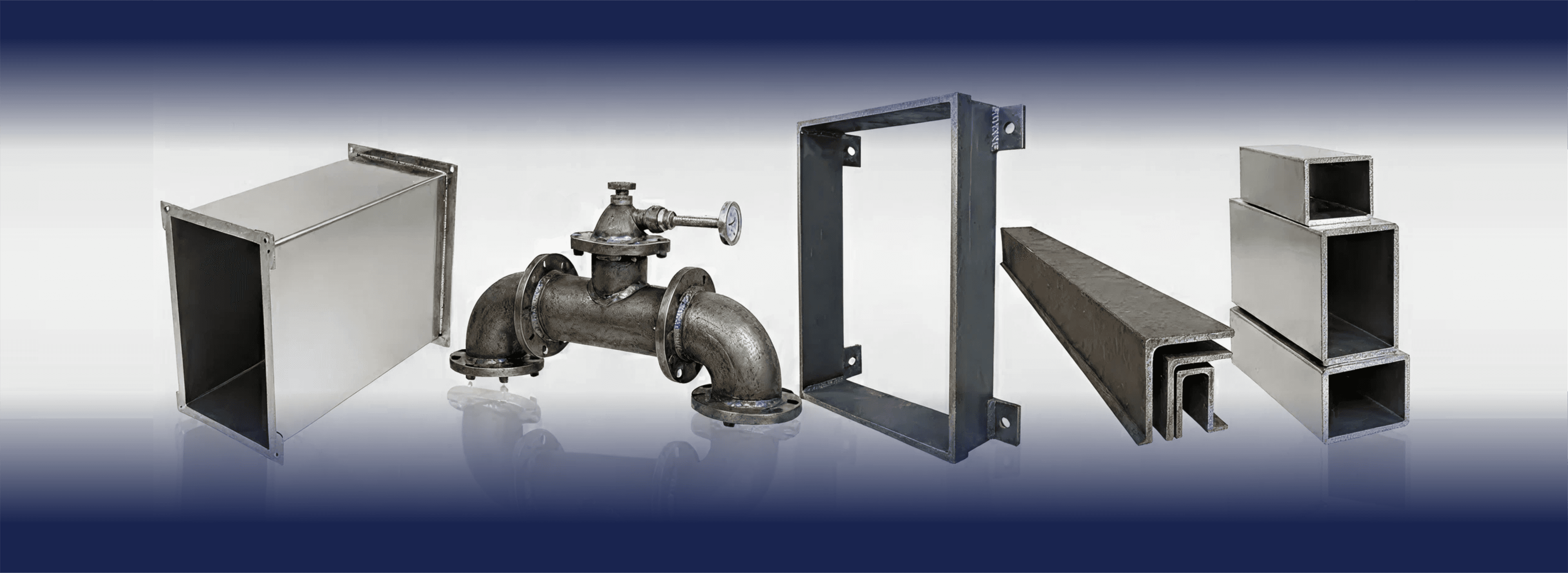
LARGE COMMERCIAL DUCT FABRICATION ORDERS
Yes, JMC Fabrication runs large commercial duct orders out of a 50,000 sq ft facility in Pascagoula, MS. The shop produces SMACNA-compliant rectangular, round, and oval duct in galvanized and stainless steel, with Revit coordination on the engineering side and staged delivery scheduled to the GC's install sequence on the field side.
The shorter answer for mechanical contractors and GCs comparing shops: capacity is real, the floor space exists, the equipment is purpose-built for HVAC volume, and the coordination workflow with Revit BIM means what's modeled is what ships.
Published May 19, 2026 · JMC Fabrication
Commercial duct production is a volume game. A single mid-rise office building can run thousands of linear feet of rectangular trunk, hundreds of fittings, and a mix of round and oval branches. Stack three or four buildings on a campus or a hospital wing and the linear-foot count climbs fast. A 50,000 sq ft facility gives JMC the floor space to run that volume without bottlenecking at the shear, the press brake, or the Autofold.
The other thing facility size buys is staging space. Finished duct doesn't ship the day it's made on most jobs. It stages until the field is ready, then it ships in install-ordered loads. A small shop running tight on floor space has to ship before the field is ready, which means the duct lives at the jobsite getting moved around, scratched, and reordered. JMC's footprint means duct can stage on JMC's floor instead of in a GC's laydown yard.
And the third reason floor space matters: large commercial projects rarely run as a single batch. They run as phases. Phase 1 ships while Phase 2 fabricates while Phase 3 details. Running concurrent phases takes physical space, and JMC's facility is sized to keep multiple phases moving without colliding on the floor.
Here's what shows up in a typical large commercial duct package, and how JMC handles each type:
- Rectangular duct: The bulk of commercial HVAC trunk and branch. JMC fabricates rectangular duct in galvanized steel per SMACNA pressure class, with seams and joints selected from the SMACNA construction details (Pittsburgh lock, snap-lock, TDC/TDF connections). Gauge follows the project's SMACNA class. The Autofold 516 handles high-volume folding for clean profiles and consistent dimensions across long production runs.
- Round duct: Spiral and longitudinal-seam round duct for return air, supply, and exhaust where round geometry fits the architectural and mechanical layout. JMC produces round duct to the project's SMACNA pressure class with fittings (elbows, tees, reducers, transitions) detailed and fabricated as a coordinated set with the trunk.
- Oval duct: Flat-oval is the answer when the design needs the airflow performance of round but the ceiling plenum height for rectangular. JMC fabricates oval duct and matching fittings for projects where space constraints force the oval profile, with the same SMACNA pressure class and gauge discipline.
- Stainless duct for specialty applications: Galvanized covers the bulk of commercial volume, but specialty scopes (food service, chemical exposure, high-humidity coastal applications, hospital and lab spaces) get stainless duct fabricated to the same SMACNA detail set. JMC runs stainless on the same equipment with the same coordination, just with separate material handling and welder qualifications.
On large commercial jobs, the difference between a smooth install and a chaotic one usually comes down to how much coordination happened before the duct hit the floor. JMC's engineering team works in Revit BIM and plugs into the customer's federated coordination model directly. That means clash detection runs against the architectural, structural, and other mechanical scopes before duct gets fabricated, not after.
What that does for the field crew: fewer field RFIs, fewer cut-and-patch fittings, and fewer pieces that have to come back to the shop because they don't fit. The shop drawings the crew installs from are generated from the same coordinated model the GC and mechanical engineer are using, so the duct that arrives matches the model that everyone agreed to.
On projects where the customer doesn't have a Revit model, JMC builds one from the customer's 2D drawings or architectural set, coordinates within the federated environment if there is one, and produces shop drawings from that source. Either way, the model and the prints stay in sync, and revisions propagate to the floor without manual redrawing.
Different project profiles call for different production and delivery patterns. Here's how JMC sequences large commercial duct work:
| Project Profile | Production Approach | Delivery Pattern | What Compresses Field Time |
|---|---|---|---|
| Single-building commercial (office, retail, light industrial) | Single production batch, sequenced by riser and floor | Floor-by-floor or zone-by-zone delivery to install order | Revit coordination, tagged install sequence |
| Campus or multi-building | Phased production matching campus phasing | Building-by-building staged loads | Federated coordination across all buildings |
| Healthcare and lab | Higher-spec gauge and class; stainless where required | Tighter zone delivery for infection control or commissioning | Clean coordination with med gas, electrical, plumbing |
| Hospitality and mixed-use | Mix of rectangular trunk, round branch, oval for tight ceilings | Staged delivery tied to occupancy phasing | Early modeling of tight ceiling plenums |
Large commercial duct doesn't ship to thin air. It ships to a mechanical contractor whose crew is running an install schedule that's tied to overhead clearances, ceiling close-in dates, and the rest of the trades. JMC's project management treats the mechanical sub as the primary customer on commercial work, with the GC as the schedule driver above them.
Practically, that means JMC's PM gets the mechanical sub's install sequence (which areas, which floors, which risers, in what order) and the production schedule shapes around it. Tagged fittings ship with the trunk they belong to. Floor-by-floor loads ship floor-by-floor. A delivery hitting the jobsite in the wrong order costs the mechanical sub crew time, and that crew time is more expensive than shop scheduling.
The other piece of mechanical contractor coordination is the punch-and-revision loop during install. Field conditions don't always match the model exactly, and small revisions come back to the shop for refabrication. JMC's engineering and shop floor share a building, so a revision ordered at 10 AM can be on a truck the next day on most fittings. That's the kind of responsiveness that keeps the field moving.
The first-pass quote on a large commercial duct order is faster and more accurate when the RFQ has the right inputs. Here's what helps:
- Project scope: total linear footage estimates by duct type (rectangular, round, oval) if available
- SMACNA pressure class and gauge requirements per the mechanical specification
- Material: galvanized for standard work, stainless for specialty scopes
- Drawings and/or Revit model access (or notice that JMC needs to build the model)
- Phase or area sequencing the GC is targeting
- Delivery location and any laydown or staging constraints on site
- Target start of mechanical install (which sets the production schedule)
- Documentation requirements (mill certs, SMACNA class records, any project-specific QC)
How large of an order can JMC handle on commercial duct?
The 50,000 sq ft facility is sized for commercial-scale volume, including multi-floor and campus projects. Capacity in any given window depends on what's already on the floor, so the most useful answer is project-specific. Send scope and target dates and JMC's PM will walk through whether the volume fits the schedule, or whether it needs to phase.
Does JMC fabricate to SMACNA?
Yes. JMC produces SMACNA-compliant rectangular, round, and oval duct, with gauge and construction details selected per the project's SMACNA pressure class. The shop's standard work follows SMACNA, and project specs that call out specific SMACNA classes or seam types are followed to the letter.
Can JMC stage delivery to match the mechanical contractor's install sequence?
Yes, and that's the standard workflow on large commercial jobs. JMC's PM takes the mechanical sub's install sequence and ships floor-by-floor, zone-by-zone, or phase-by-phase to match. Tagged fittings ship with their trunk, and the load order matches the install order so the field crew isn't sorting parts on site.
What if our design is in Revit but JMC's engineering needs to detail the duct?
That's a common workflow. The customer or mechanical engineer provides the Revit model with the duct routed at design intent. JMC's engineering team picks up from there, details the duct to SMACNA construction (seams, joints, hangers, supports), produces shop drawings, and runs final clash detection. The federated model stays in sync with the shop drawings throughout.
How does JMC handle revisions during install?
Revisions get re-detailed against the current model, the affected shop drawings get reissued, and refabricated pieces ship as quickly as production allows. Because engineering, the shop, and QC share a building, a typical small revision can be refabricated and on a truck the next business day. Larger revisions get scheduled into the production queue with the PM coordinating with the mechanical sub.
Does JMC's duct work include hangers, supports, and accessories?
Standard duct hangers, supports, and accessories per SMACNA are fabricated as part of the package on most commercial jobs. Specialty supports, seismic detailing, or unusual accessories are quoted separately when they're outside SMACNA-standard scope. The RFQ stage is where that scope gets locked in.
What's the lead time on a large commercial duct order?
Lead time depends on volume, material, and current shop loading. The honest answer is that JMC's PM gives a real number once the scope and schedule are reviewed, not a generic catalog number. For early budgeting, the rule of thumb is that large commercial duct fabrication scales with linear footage and fitting count, and JMC's facility size lets the shop run multiple large jobs concurrently when sequencing allows.