
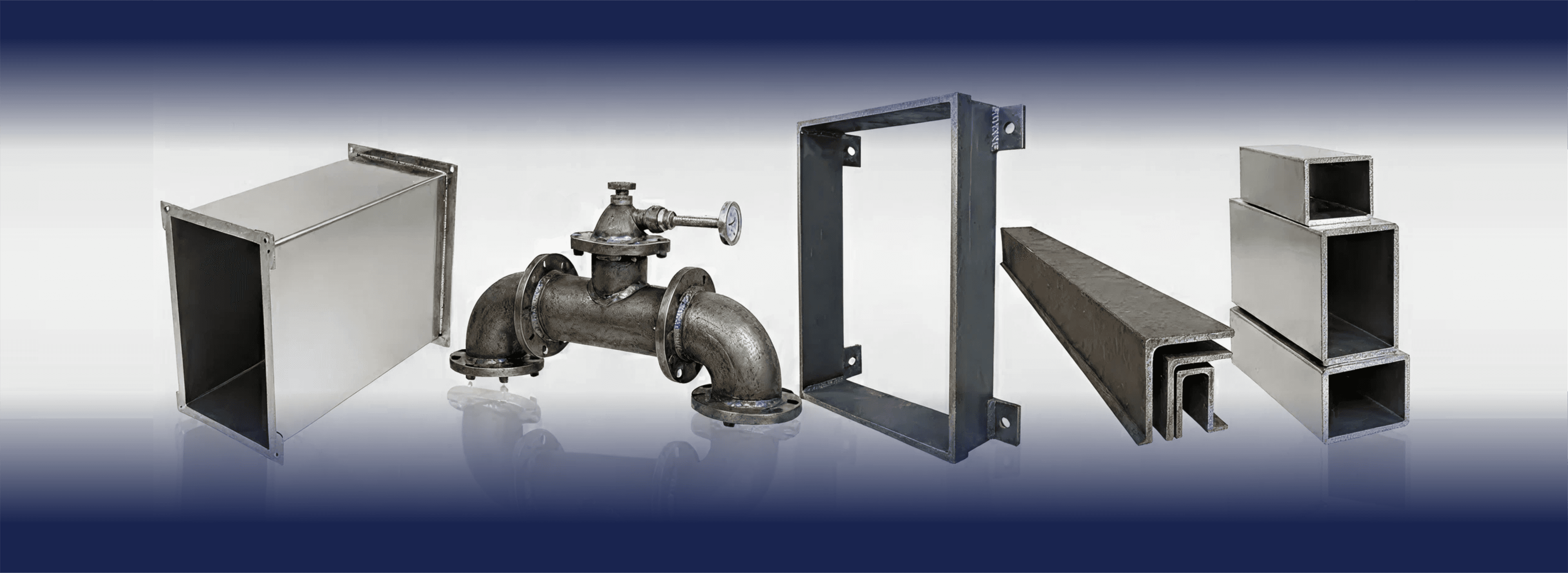
MATERIALS JMC FABRICATION WORKS WITH
JMC Fabrication runs carbon steel, stainless steel (304 and 316), galvanized steel, and copper through the shop every day. Material choice drives weld procedure, code path, finish requirement, and what shows up in the closeout package, so JMC's engineering team locks down material at the quote stage and traces every piece back to its MTR.
The shorter answer for buyers checking material capability: yes, JMC works in the metals industrial mechanical and marine projects actually call for, and we source to spec with mill test reports tied to each heat.
Published May 19, 2026 · JMC Fabrication
Material gets picked early because everything downstream depends on it. The weld procedure specification is qualified to a material group. The NDE method has to fit the metal. The corrosion behavior decides whether the part survives year two. And the documentation package has to show MTRs that match what's actually in the part. Push material selection late and the cost shows up in rework, requalification, or a field replacement two summers later.
JMC's engineering team works through material choice at the quote stage, not after the PO. That means looking at service environment, code requirements, joining method, and budget together. A duct run inside a conditioned office gets galvanized. A duct run carrying salt-laden air on a Gulf Coast roof gets stainless. A pump skid carrying produced water gets carbon steel with a coating system, or it gets stainless if the chloride load is high enough. The wrong call gets expensive fast.
Once material is locked, the rest of the engineering deliverable falls in behind it: WPS selection, filler metal, NDE plan, and the MTR routing for closeout. That's the whole reason JMC's engineering, shop, and QC teams sit in the same building. The material decision and the procedure that backs it have to move together.
Here's what each metal is good at, where it shows up in JMC's work, and what to watch for at quote time:
- Carbon steel: The workhorse. A36 plate, A53 and A106 pipe, structural shapes. Carbon steel covers pipe spools for oil and gas, structural subbases, equipment frames, and heavy weldments. It welds cleanly with common procedures, takes paint and protective coatings well, and the per-pound cost is low. JMC uses carbon steel by default unless the service environment or code path argues for something else.
- Stainless steel (304 and 316): Corrosion resistance. 304 stainless is the standard for food-grade, light chemical, and indoor stainless work. 316 adds molybdenum and handles chlorides, which is why it's the call for marine, coastal, and saltwater-exposed scopes. JMC fabricates stainless duct, pipe spools, and custom assemblies, and the welding procedures are qualified separately from carbon steel work.
- Galvanized steel: The SMACNA-compliant default for commercial HVAC duct. Hot-dip galvanized sheet is what most rectangular, round, and oval duct gets made from, and the gauge is selected per SMACNA pressure class. JMC runs galvanized through the press brake, shear, and Autofold 516 every day on commercial duct packages. Galvanized doesn't weld like bare carbon steel, so seam and joint design follow SMACNA construction details.
- Copper: Specialty. Copper shows up in piping assemblies, condensate work, and specialty system fabrication where its conductivity, corrosion behavior, or code requirement makes it the right call. JMC handles copper alongside the carbon, stainless, and galvanized work for projects that need a mix of materials in one delivered package.
Welding isn't material-agnostic. A weld procedure specification is qualified to a specific material group, filler metal, position, and process. Carbon steel WPS doesn't cover stainless. Stainless WPS doesn't cover galvanized. And inside stainless, the procedure for 304 isn't automatically valid for 316 thicknesses outside the qualified range. That's why JMC's WPS library is organized by material first, then by process and thickness range.
On AWS-certified structural and pipe work, JMC's welders qualify to the procedures that match the project's material. On NAVSEA scopes, the procedure path is tighter still, the welders carry the cert that matches the procedure, and the weld log has to back-trace to both. Material choice at the quote stage decides which welders and which procedures the job runs on.
Filler metal selection follows the same logic. Carbon steel gets carbon-compatible filler. 304 typically welds with 308 or 309 filler depending on dilution and end use. 316 welds with 316L filler for most service. Galvanized seams use mechanical joining (Pittsburgh lock, snap-lock, S-cleat) per SMACNA rather than welding through the zinc coating, because burning galvanized produces fumes and weakens the corrosion barrier.
Different services point to different metals. Here's how JMC matches material to scope:
| Material | Where It Fits | Typical JMC Application | Key Documentation |
|---|---|---|---|
| Carbon steel (A36, A53, A106) | Structural, process piping, oil & gas, equipment frames | Pipe spools, pump skids, structural subbases, mounting frames | MTR, WPS, weld log, coating spec |
| Stainless 304 | Indoor stainless, food-grade, light chemical, dry corrosive service | Process pipe spools, custom assemblies, indoor stainless duct | MTR, WPS, NDE per spec |
| Stainless 316 | Marine, coastal, chloride-bearing, saltwater exposure | Marine pipe spools, exterior stainless duct, coastal weldments | MTR, WPS, NDE, optional PMI |
| Galvanized steel | SMACNA-compliant commercial HVAC, indoor duct, light architectural | Rectangular, round, and oval duct per SMACNA pressure class | Mill cert, SMACNA gauge/class records |
| Copper | Specialty piping, condensate, code-required copper systems | Copper piping assemblies, specialty system components | MTR, joint method records |
Real projects rarely use one material. A mechanical room for a Gulf Coast commercial build might want galvanized duct, carbon steel structural supports, stainless flashing where the duct exits the roof, and copper for a small condensate run. A marine retrofit might call for 316 pipe spools, carbon steel mounting brackets, and stainless penetration sleeves. The package gets fabricated, documented, and delivered as one set even though it's drawing on three or four different WPS files and multiple MTR routings.
JMC handles mixed-material packages by keeping the material identity tied to the drawing from quote through delivery. Each piece carries the heat number and MTR reference back to receiving. The shop tags maintain material separation to prevent cross-contamination, especially keeping stainless work clear of carbon steel grinding dust. And the closeout package shows each material group with its own procedures, certs, and inspection records.
Material transitions inside a single assembly (a stainless-to-carbon flanged joint, for example) get their own callout on the drawing so the joint design, gasket, and bolting are explicit. That kind of detail is what keeps a mixed-material assembly from becoming a corrosion problem later.
Material traceability is part of what makes a closeout package useful instead of decorative. Here's how JMC handles sourcing and documentation:
- Mill test reports (MTRs) are pulled at receiving, matched to the heat number on the material, and filed against the project
- Stock material is segregated by alloy on the shop floor; stainless and carbon don't share grinding stations
- Material substitutions get reviewed against the project spec before they happen, not after
- Closeout packages include MTRs for all pressure-bearing and code-driven material, plus mill certs for SMACNA duct gauges where the spec requires it
- On NAVSEA and oil & gas work, material traceability follows the project's specific traceability matrix, with heat numbers tracked piece-by-piece through fabrication
- Long-lead alloys (specific stainless grades, heavier wall thicknesses) get flagged at quote time so schedule and procurement track together
What's the difference between 304 and 316 stainless, and when does JMC use each?
304 stainless is the general-purpose stainless: food-grade, indoor chemical, dry corrosive service. 316 adds molybdenum, which improves chloride resistance, and that's why it's the standard for marine, coastal, and saltwater exposure. On a Pascagoula or Gulf Coast project, JMC defaults to 316 when the part sees salt air or marine water, and 304 when the corrosion driver is something else.
Why is galvanized steel the default for commercial duct?
SMACNA construction standards are written around galvanized sheet, and the gauge tables that pressure-class commercial HVAC duct assume hot-dip galvanized. The zinc coating protects the steel from atmospheric corrosion at a cost point that works for commercial-scale projects. JMC switches to stainless duct when the application calls for it (food service, chemical, high humidity), but galvanized covers the bulk of commercial HVAC volume.
Does JMC supply MTRs with finished work?
Yes. Mill test reports are pulled at material receiving and filed against the project. For pressure-bearing pipe spools, NAVSEA scopes, and any work where the spec calls for traceability, MTRs ship with the closeout package along with weld logs and NDE reports. For commercial duct packages, mill certs are available on request and are included by default on jobs where the spec requires them.
Can JMC weld carbon steel to stainless steel?
Yes, when the joint design and service conditions support it. Carbon-to-stainless welds use a filler metal selected for the dilution and end service, often a 309-type filler. JMC's WPS library covers carbon-to-stainless joints, and the joint gets its own callout on the drawing so the gasket, bolting, and any galvanic isolation are explicit. For pressure or code-driven joints, the WPS and the welder cert both have to match the joint type.
What about aluminum or exotic alloys?
JMC's standard production materials are carbon steel, stainless (304/316), galvanized, and copper. Other metals come up case-by-case and are reviewed at quote time against the welding procedure library and project schedule. If a project needs an alloy outside the standard list, JMC's engineering team flags it during RFQ review so material lead time and procedure qualification get scoped before the PO.
How does JMC keep stainless and carbon steel from cross-contaminating on the shop floor?
Material segregation is part of the shop floor layout. Stainless work runs on dedicated stations and tools where practical, and grinding wheels, wire brushes, and clamps used on carbon steel don't touch stainless. Cross-contamination from carbon steel particles is what causes free-iron corrosion on stainless surfaces, so keeping the materials separate is a basic quality discipline, not an afterthought.
If I'm not sure which material my project should use, can JMC help spec it?
Yes. Material selection is part of the engineering review on most RFQs. JMC's team will look at the service environment (indoor/outdoor, chloride load, temperature, fluid or gas being handled), the code path, and the budget, and make a recommendation. For projects coming in with a fixed material spec from the customer's engineer, JMC fabricates to spec. For projects where the customer is open to a recommendation, JMC's engineering team will walk through the tradeoffs at quote stage.