
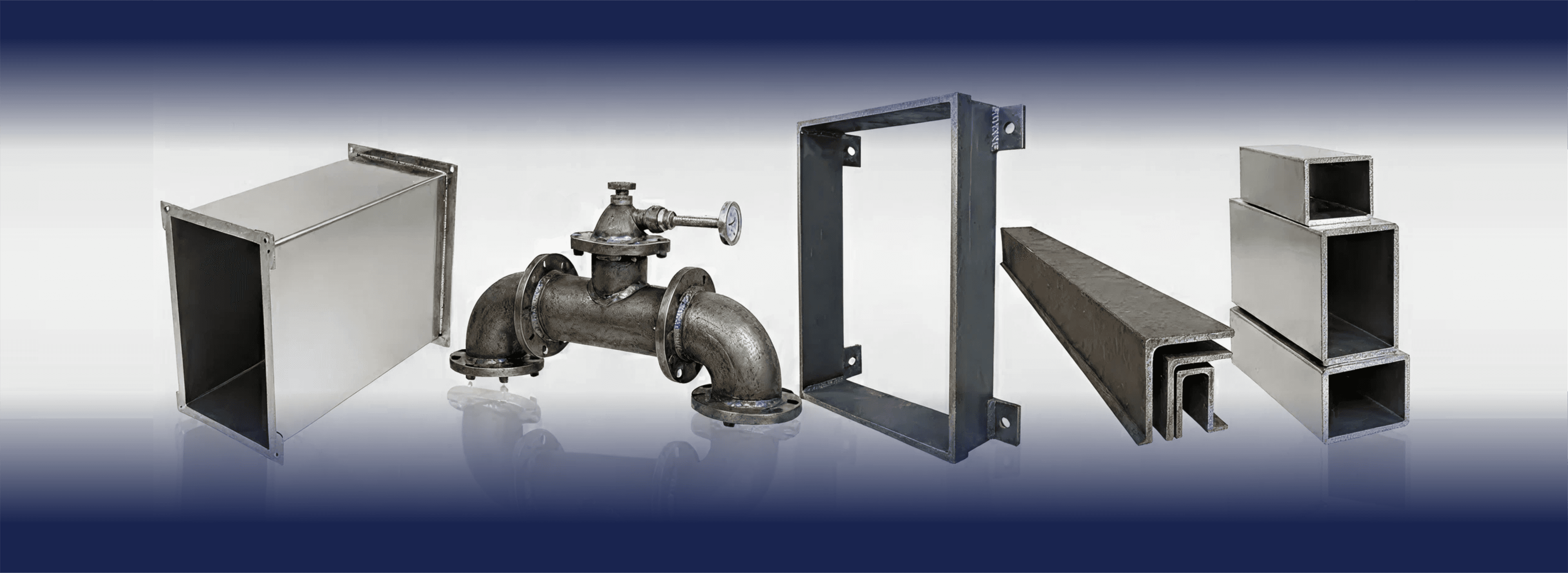
CARBON STEEL VS. STAINLESS STEEL FABRICATION: CHOOSING THE RIGHT MATERIAL
Material selection is one of the first and most consequential decisions in any fabrication project. Choose wrong and you're dealing with premature corrosion failures, weld quality problems, or unnecessary cost.
This guide is written for engineers, project managers, and procurement leads who need to get it right, particularly in marine and industrial environments where the stakes are high.
Published May 13, 2026 · JMC Fabrication
Carbon steel is the most widely used engineering material in industrial fabrication. The combination of high strength, excellent weldability, and relatively low cost makes it the default choice for a wide range of structural and piping applications.
Key properties:
- High tensile and yield strength for structural and pressure-containing applications
- Excellent weldability, the easiest metal to weld economically at scale
- Significantly lower cost than stainless in both material and fabrication labor
Common grades in industrial fabrication:
- ASTM A36: the standard structural grade for frames, supports, and base plates
- ASTM A53/A106: standard pipe grades for process piping applications
The limitation: carbon steel corrodes without protection. In dry environments, coating (paint, epoxy, galvanizing) extends service life effectively. In environments with aggressive moisture, saltwater, or chemical contact, coating is not a long-term solution, and stainless steel is the appropriate choice.
Stainless steel achieves its corrosion resistance through chromium content. A minimum of 10.5% chromium causes the formation of a passive chromium oxide layer on the surface, a self-repairing barrier that protects the base metal in corrosive environments.
Key properties:
- Corrosion resistance: the primary reason to specify stainless over carbon steel
- High-temperature performance: maintains strength and oxidation resistance at elevated temperatures
- Low maintenance: the passive layer is self-repairing, no protective coating required
- Weldability: more demanding than carbon steel, requires tighter procedure controls and material segregation to prevent carbon contamination
Cost reality: stainless is significantly more expensive than carbon steel in raw material cost, and the welding procedures required drive additional labor cost. In the right service environment, stainless is the lower-cost option over the life of the asset.
Common grades:
- 304 stainless: the most common grade, general corrosion resistance for most applications
- 316 stainless: enhanced corrosion resistance through molybdenum addition, the standard for marine and chloride-exposed applications
Property                  Carbon Steel         Stainless Steel
──────────────────────    ─────────────────    ────────────────────
Corrosion Resistance      Low (needs coating)  High (passive layer)
Tensile Strength          High                 High (comparable)
Material Cost             Lower                Higher (3 to 5x)
Welding Complexity        Standard             More demanding
Maintenance               Higher               Lower
Common Applications       Structural,          Marine, chemical,
                          process piping,      food service,
HVAC duct high-puritySaltwater is a highly corrosive environment. Carbon steel without protective coating corrodes rapidly in saltwater immersion or salt spray conditions, making stainless steel the engineering default for marine piping systems where long service life is the priority.
NAVSEA specifications frequently require stainless steel for pipe systems in saltwater service. Grade 316 is preferred for marine applications because the molybdenum addition improves resistance to chloride-induced pitting corrosion, the dominant corrosion mechanism in marine environments.
That said, carbon steel remains widely used in marine construction for structural work above the waterline, galvanized or epoxy-coated in non-immersed conditions. The material decision follows the service environment.
JMC fabricates for both: NAVSEA certified for marine stainless work, AWS certified across both materials.
Most process piping in oil and gas facilities is carbon steel. At the scale of a refinery, chemical plant, or offshore platform, where pipe inventories run to miles of installed piping, the cost economics of carbon steel at scale are compelling. A53 and A106 carbon steel cover the majority of process piping service conditions.
Where stainless is specified in oil and gas: chemical injection lines, instrumentation tubing, high-chloride process streams, and offshore subsea applications where carbon steel coating cannot be maintained. For sour service (H2S environments), carbon steel selection must account for hydrogen induced cracking (HIC) and sulfide stress cracking (SSC) risks per NACE MR0175. Consult your materials engineer for sour service applications.
SMACNA specifies galvanized carbon steel as the standard material for commercial HVAC duct construction. Galvanizing, hot-dip zinc coating applied to carbon steel, provides corrosion protection suitable for commercial HVAC environments without the cost of stainless steel.
Stainless duct is specified for food service facilities, pharmaceutical clean rooms, chemical manufacturing environments, and other applications where zinc coating is inappropriate or where health codes require it.
JMC's commercial duct practice is built on galvanized carbon steel. Stainless duct is available for applications where it is specified or required.
- What is the service environment? — Salt water, chemical contact, and aggressive corrosives point to stainless. Dry, coated, or low-moisture environments support carbon steel.
- What does the specification say? — SMACNA, ASME, NAVSEA, and NACE standards often dictate material selection. Follow the spec first.
- What is the expected service life and maintenance plan? — Stainless has lower lifetime maintenance cost in corrosive environments. Carbon steel has lower upfront cost with ongoing coating maintenance.
- What is the budget? — Stainless steel is typically 3 to 5 times more expensive than carbon steel on equivalent fabricated assemblies. Where the service environment doesn't require it, that premium adds cost without adding value.
JMC fabricates in carbon steel, stainless steel, and galvanized steel. AWS certified welding applies to both. NAVSEA certification covers marine stainless applications. Our engineering team can review material requirements and help resolve material selection questions before fabrication begins.
No preference for which material you specify, we want the right answer for your project.
Material selection is not a guess, it's an engineering decision driven by service environment, code requirements, and total cost of ownership. Use the spec when you have one. Use the service environment when you don't. When it's still unclear, your fabricator should be able to help you work through it before you commit to an RFQ.
This article supports the following JMC capabilities: