
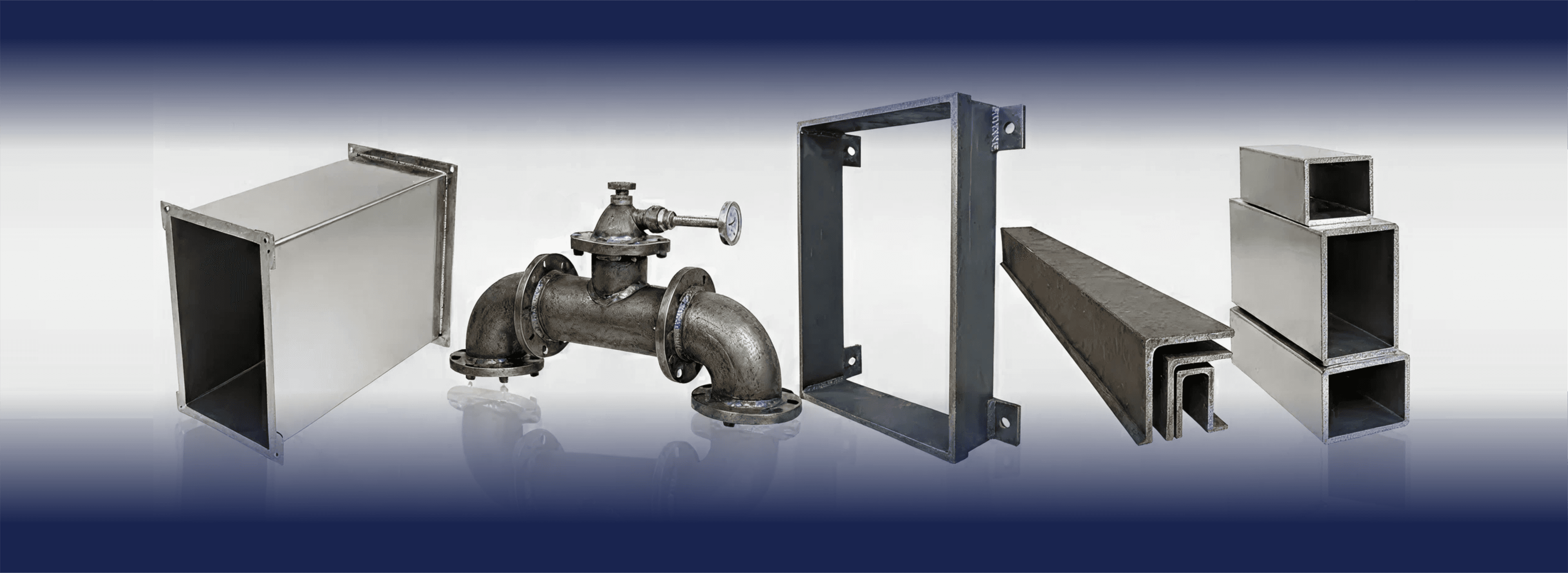
SMACNA DUCT COMPLIANCE AT JMC FABRICATION
Yes, JMC Fabrication builds HVAC duct in compliance with SMACNA's HVAC Duct Construction Standards, which govern material gauge, seam construction, reinforcement spacing, and allowable leakage by pressure class. SMACNA isn't a certification stamp on the shop, it's a construction standard JMC fabricates to, with shop drawings and material selection driven directly by the project's pressure class and seal class.
For GCs and mechanical contractors, that means the duct coming off JMC's floor matches the gauge schedule, seam type, and reinforcement spacing the mechanical spec calls for, with shop drawings that show the logic, not just the geometry.
Published May 19, 2026 · JMC Fabrication
SMACNA is the Sheet Metal and Air Conditioning Contractors National Association. Their HVAC Duct Construction Standards, Metal and Flexible, is the document the entire commercial mechanical industry uses to size, build, and seal rectangular and round duct. When a mechanical engineer writes 'duct shall be constructed per SMACNA' on a drawing, they're calling out that whole construction logic.
The standard covers four big areas: material gauge selection by pressure class and duct size, seam and joint construction (how you put two pieces of sheet metal together), reinforcement spacing (how you keep big duct from oil-canning under pressure), and seal class (how leak-tight the system has to be). Get any one of those wrong and the duct still looks right, but it fails performance.
SMACNA also publishes companion standards for round duct, kitchen exhaust, fibrous glass duct, and industrial duct, but the HVAC Duct Construction Standards is the one driving most commercial work JMC fabricates.
Before a gauge gets picked or a seam gets chosen, the engineer assigns a pressure class to the duct system. SMACNA defines six standard pressure classes on rectangular duct, expressed in inches of water gauge (wg): 1/2, 1, 2, 3, 4, 6, and 10. Lower pressure classes are typical for return air and low-velocity supply. Higher pressure classes show up on medium- and high-velocity supply, lab exhaust, and industrial systems.
The pressure class drives gauge, drives reinforcement spacing, drives seam options, and drives the allowable leak rate. A 2 inch wg system at 36 inches wide doesn't get built the same way as a 4 inch wg system at the same width. SMACNA's gauge tables make those decisions explicit, not subjective.
When JMC builds shop drawings, the pressure class shows up on each duct run callout, so a field inspector or mechanical PM can verify against the spec without back-channel questions.
Gauge selection is the most visible SMACNA decision. This table is a simplified view of how gauge scales with pressure class and duct size on rectangular galvanized duct. Always defer to the current SMACNA tables on a real project, since reinforcement choice can shift the allowable gauge:
| Duct Dimension (longest side) | 1/2" wg | 2" wg | 4" wg | 6" wg |
|---|---|---|---|---|
| Up to 12" | 26 ga | 26 ga | 24 ga | 22 ga |
| 13" to 30" | 24 ga | 24 ga | 22 ga | 20 ga |
| 31" to 54" | 22 ga | 22 ga | 20 ga | 18 ga |
| 55" to 84" | 20 ga | 20 ga | 18 ga | 16 ga |
| 85" and up | 18 ga | 18 ga | 16 ga | 16 ga |
A seam is how two pieces of sheet metal get joined longitudinally inside a duct section. SMACNA recognizes several seam types, and the choice depends on pressure class, sheet thickness, and shop equipment. The common ones JMC runs:
- Pittsburgh lock seam: The default longitudinal seam on most rectangular duct. One edge is bent into a pocket, the other edge slides in, then the pocket is hammered or rolled closed. Strong, leak-resistant, and the standard choice across pressure classes when shop equipment supports it.
- Snap lock (button punch): A quicker seam where the two edges interlock without needing to be rolled or hammered. Common on lower pressure class supply and return duct where speed matters and the spec doesn't call for Pittsburgh.
- Standing seam (Acme grooved): Used on heavier-gauge duct where a flat seam isn't structurally adequate. The seam sits proud of the duct face, which gives reinforcement and rigidity at the same time.
- Drive cleat and S-cleat (transverse joints): Transverse joints are how duct sections connect end-to-end. Drive cleat slides over the joint and gets bent in. S-cleat (or S-slip) joins two sections via an S-shaped strip. Both are SMACNA-allowed transverse joints for lower pressure classes; higher pressure classes call for flanged joints (TDF, TDC, or angle flanges).
- TDF, TDC, and angle-flange transverse joints: On medium- and high-pressure systems, the transverse joint becomes a flange. TDF (transverse duct flange) and TDC (transverse duct connector) are integral rolled flanges. Angle iron flanges are used on the largest duct or where a project spec calls for it.
Even at the right gauge, a large duct will flex and oil-can under static pressure unless it's reinforced. SMACNA publishes reinforcement schedules that pair gauge and dimension with reinforcement type (tie rods, cross-breaks, internal stiffeners, external angles) and the maximum spacing between reinforcements along the duct length.
Reinforcement choice and spacing trades off against gauge. A shop can sometimes go thinner on metal if reinforcement is closer, or skip an intermediate reinforcement if the gauge is heavier. The SMACNA tables let the engineer or fabricator pick the most cost-effective combination as long as the resulting duct still meets the pressure class.
JMC's shop drawings call out reinforcement type and spacing explicitly on each duct run. That's what a mechanical PM checks against the spec, and it's what the GC's QC inspector verifies in the field.
SMACNA defines three seal classes on rectangular duct: Seal Class A (all transverse joints, longitudinal seams, and duct wall penetrations sealed), Seal Class B (all transverse joints and longitudinal seams), and Seal Class C (transverse joints only). The seal class is paired with the pressure class on the mechanical spec.
Allowable leakage is calculated per SMACNA's leakage equation and reported as CFM per 100 square feet of duct surface area at the test pressure. On commercial work, leak testing is sometimes performed on duct mockups or completed sections, and the leak class on the spec is the target.
Sealant selection (mastic, tape, gasketing on flanges) follows from the seal class. JMC's shop process applies sealant before duct leaves the shop on systems that call for shop-applied sealing, and the rest is sealed in the field per the mechanical contractor's process.
A clean SMACNA shop drawing reads like a build sheet, not just a geometry plot. On JMC's drawings, each duct run shows:
- Pressure class and seal class for the system the duct belongs to
- Material (galvanized, stainless, aluminum) and gauge per section
- Longitudinal seam type (Pittsburgh, snap lock, standing seam)
- Transverse joint type (drive/S-cleat, TDF, TDC, angle flange) and gasket where required
- Reinforcement type and maximum spacing
- Hanger spacing and support type by SMACNA hanger tables
- Sealant callouts where shop-applied sealing is part of the scope
Commercial mechanical specifications almost universally invoke SMACNA. When a GC bids a project, they need to know the duct subcontractor and the fab shop can both produce to that spec without the engineer of record red-pen marking up shop drawings.
On JMC's side, SMACNA compliance is built into the shop drawing workflow, not added at QC. The drawing template asks for pressure class on every run. Gauge selection populates from the SMACNA tables. The reinforcement schedule is plotted with the drawing. By the time a duct piece goes on the truck, it was already specified, drawn, and built to the standard.
For mechanical contractors, that means fewer field rejections and fewer rework loops. For GCs, it means a cleaner submittal package on the front end and a leaner closeout on the back end.
Is SMACNA a certification or a construction standard?
It's a construction standard. There's no SMACNA stamp on a shop the way AWS or NAVSEA certifies a welder. What SMACNA-compliant means is that the shop fabricates per the SMACNA HVAC Duct Construction Standards: the right gauge for the pressure class, the right seams and joints, the right reinforcement spacing, and the seal class the spec calls for. JMC fabricates to that standard.
What pressure classes does JMC build to?
JMC builds to the SMACNA pressure classes the project specifies, typically 1/2, 1, 2, 3, 4, and 6 inches wg on commercial work. Higher pressure systems and industrial scopes get evaluated on a project basis since they sometimes require flanged construction, heavier gauges, and tighter seal classes.
Can JMC fabricate stainless or aluminum duct, not just galvanized?
Yes. SMACNA covers galvanized steel, carbon steel, stainless steel, and aluminum duct, with separate gauge tables for each material. JMC's shop fabricates in carbon steel, galvanized, stainless, and copper. Stainless and aluminum duct are common on kitchen exhaust, lab exhaust, and corrosive process exhaust.
Does JMC offer SMACNA leak testing or just SMACNA fabrication?
Fabrication is to SMACNA. Leak testing is sometimes performed on completed duct systems in the field by the mechanical contractor. If a project spec requires shop-side leak testing on duct mockups or sections, that gets scoped at the project start so the right test equipment and witnesses are arranged.
What seam type does JMC use by default on rectangular duct?
Pittsburgh lock seam is the default longitudinal seam on most JMC rectangular duct. Snap lock is used on lower pressure class systems where the spec doesn't require Pittsburgh. Transverse joints scale with pressure class, drive/S-cleat on low pressure, TDF or TDC on higher pressure, with angle flanges where the spec calls for it.
Will SMACNA shop drawings show up in the submittal package?
Yes. JMC's submittal package for duct fabrication includes shop drawings annotated with pressure class, seal class, gauge per section, seam and joint types, and reinforcement spacing. The drawing set is what the mechanical engineer reviews before fabrication starts and what the GC keeps for closeout.
Can JMC fabricate round and oval duct in addition to rectangular?
Yes. SMACNA's round duct standard covers spiral lock-seam round and oval duct. JMC fabricates rectangular as the bulk of the work, and runs round and oval where the project calls for it. The gauge and reinforcement logic for round duct sits in the SMACNA round duct standard, not the rectangular tables.