
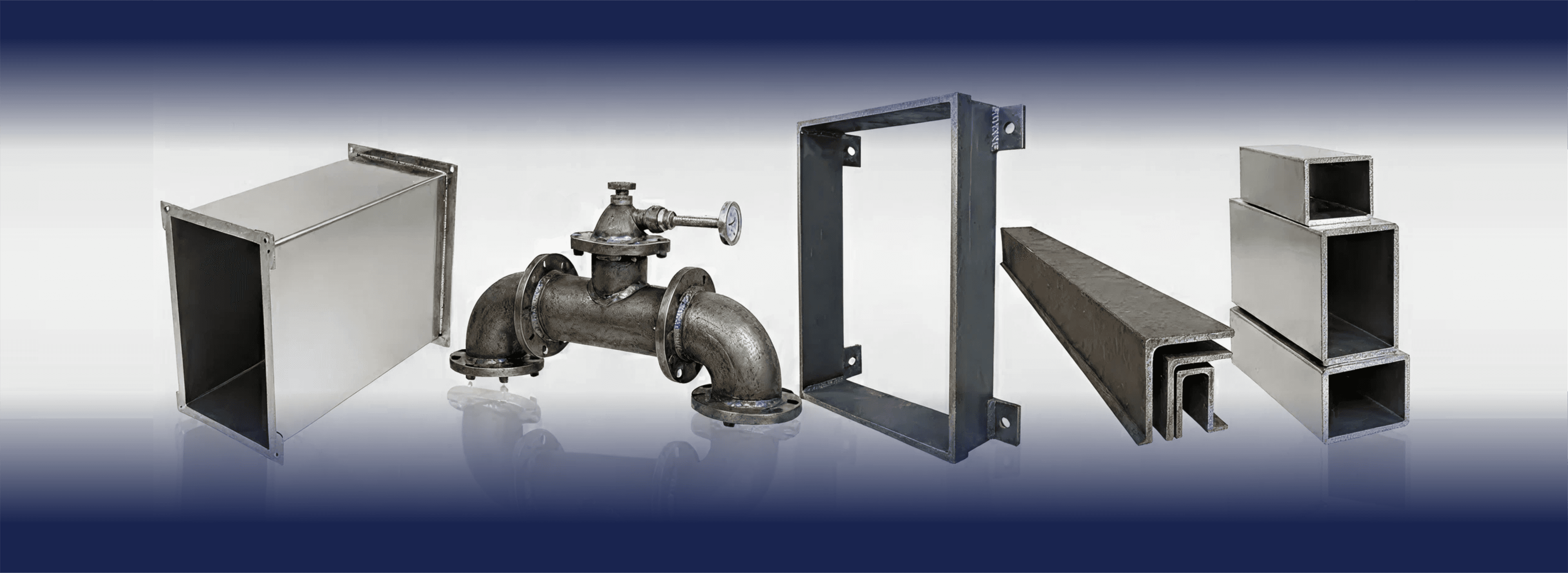
DATA CENTER DUCT FABRICATION
Data center duct is a volume and schedule problem more than a specification problem. The construction class is usually straightforward commercial SMACNA work, but the linear footage is large, the fittings repeat, and the mechanical schedule is compressed because the building has a commissioning date tied to equipment delivery. JMC fabricates that scope from a 50,000 square foot shop in Pascagoula, MS.
Here is what changes when the duct package is for a data center, and where a fabricator either helps or hurts the schedule.
Published August 5, 2026 · JMC Fabrication
The airflow volumes are large and the geometry is repetitive. Where an office building has hundreds of small branches feeding individual spaces, a data hall has large trunk moving a lot of air into a containment arrangement, repeated across halls that are close to identical. That repetition is an advantage in fabrication, because a coordinated set of fittings can be produced as a run rather than as one-offs.
The schedule is the hard part. Mechanical install on a data center is usually sequenced against equipment arrival and a fixed commissioning window, and the duct is on the critical path into that window. A late package does not just delay duct, it delays the air balance, which delays commissioning, which delays the handover the owner has already scheduled around.
The third difference is that data center work tends to come in phases across halls or buildings, and the phases overlap. Phase one is installing while phase two fabricates and phase three details. Running concurrent phases takes physical floor and staging space, which is what JMC's three warehouses and 50,000 square feet of covered storage exist for.
The mix skews toward large trunk and repeatable fittings:
- Large rectangular trunk: The bulk of the package, fabricated to the project SMACNA pressure class with gauge and reinforcement sized for the static the design carries.
- Round and spiral: Where round geometry fits the layout better than rectangular, including return paths and exhaust. Spiral runs long and installs fast, which matters on a compressed schedule.
- Repeating fitting sets: Transitions, elbows, tees, and takeoffs that repeat hall to hall. Fabricated as coordinated production runs rather than individually detailed pieces.
- Support and generator ventilation: Duct for generator rooms, electrical rooms, battery rooms, and make-up air, which carry different requirements than the data hall itself.
Same standard, different production and delivery profile:
| Attribute | Typical commercial | Data center |
|---|---|---|
| Fitting variety | High, many one-offs | Lower, highly repetitive |
| Trunk size | Moderate | Large, high volume |
| Schedule pressure | Tied to ceiling close-in | Tied to a fixed commissioning date |
| Phasing | Floor by floor | Hall by hall or building by building, overlapping |
| Biggest fabrication risk | Coordination in tight plenums | Throughput and on-time staged delivery |
Two things do most of the work. First, coordination happens before fabrication. JMC's engineering team works in Revit and runs clash detection against the customer's federated model, so pieces are not being cut and patched in the field on a job where field labor is the expensive resource.
Second, delivery is staged to the install sequence rather than pushed as it is produced. The mechanical contractor's crew gets loads in the order they are installing, tagged to the hall and zone they belong to. Finished duct that the field is not ready for stages at JMC rather than on the site.
The freight math also matters on a duct package this bulky. Sourcing regionally from Pascagoula rather than from out of state takes real cost out of a large package, and shortens the window between a revision and a replacement piece arriving.
- SMACNA pressure class and gauge requirements from the mechanical specification
- Estimated linear footage by duct type, and the fitting count if the takeoff exists
- Revit model access, or notice that JMC needs to build the model from the drawing set
- Hall or building phasing and the target commissioning date driving it
- Delivery location and any site staging constraints
- Documentation requirements, including mill certificates and construction class records
Does JMC fabricate duct for data center projects?
Yes, as part of its commercial duct work. Data center packages are usually standard SMACNA construction at large volume with repetitive fittings, which suits a shop sized for high-volume production. The construction class follows the project mechanical specification.
Can JMC keep up with a compressed data center schedule?
Capacity in any given window depends on what is already on the floor, so the honest answer is project-specific. Send the scope and the commissioning date and JMC's project management will say whether the volume fits the schedule or whether it needs to phase. The 50,000 square foot facility is sized to run concurrent phases when sequencing allows.
How does JMC handle repetitive fittings across identical halls?
As production runs. Once a fitting set is detailed and approved for one hall, the repeats are fabricated as a batch rather than re-detailed individually, which is both faster and more consistent dimensionally across halls.
Does JMC coordinate data center duct in Revit?
Yes. Engineering works in Revit and coordinates against the customer's federated model, running clash detection before fabrication rather than after. Where the customer has no model, JMC builds one from the drawings and produces shop drawings from it.
Can delivery be staged hall by hall?
Yes, and that is the standard approach. Loads ship in install order, tagged to the hall and zone, with the balance of the package staging at JMC's facility until the field is ready for it.