
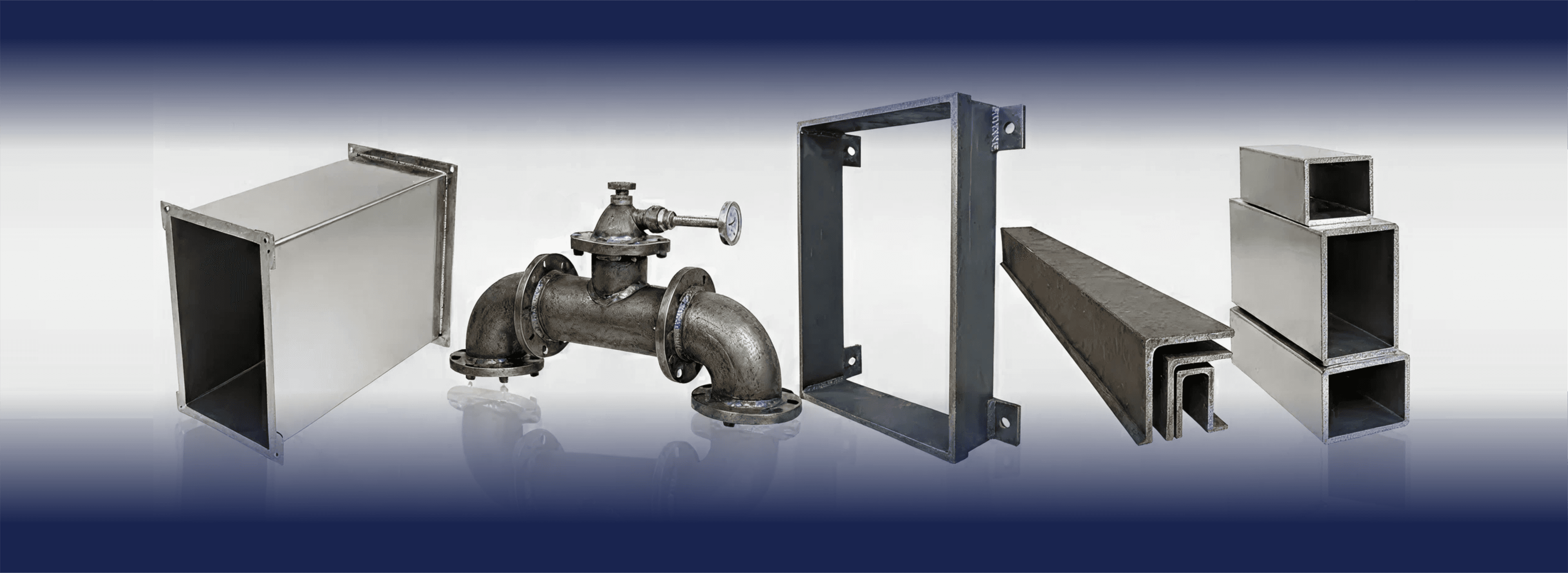
HOSPITAL AND HEALTHCARE DUCT FABRICATION
Healthcare is the highest-specification commercial duct work JMC fabricates. The mechanical specification usually drives a higher SMACNA pressure class, tighter leakage limits, stainless in specific areas, and a documentation package that has to survive commissioning. JMC builds that scope in galvanized and stainless steel from its Pascagoula, MS shop.
What follows is what actually changes when a duct package is for a hospital rather than an office building, and what a mechanical contractor should send with the RFQ.
Published August 5, 2026 · JMC Fabrication
The air in a hospital is doing more work than the air in an office. Pressure relationships between spaces have to hold, air change rates are set by the space type rather than by comfort, and the filtration and pressurization design assumes the duct itself is not leaking air between zones. That assumption is what pushes healthcare duct into a higher construction class than most commercial work.
Practically, three things move. Pressure class goes up, which drives gauge and reinforcement. Leakage class tightens, which drives sealing method and joint selection. And material changes in specific areas, with stainless showing up in surgical suites, sterile processing, lab exhaust, and anywhere the design anticipates washdown or chemical exposure.
The fourth thing that moves is the paperwork. Healthcare projects are commissioned, which means someone is going to test the system and compare it against the submitted construction records. Duct that was built right but documented loosely creates the same schedule problem as duct that was built wrong.
A hospital duct package is rarely one material. It is usually galvanized with stainless in defined areas:
- Galvanized steel: The bulk of the package. General supply, return, and exhaust trunk and branch throughout patient rooms, offices, corridors, and support spaces, fabricated to the project SMACNA pressure class.
- Stainless steel: Surgical suites, sterile processing, and lab exhaust where the design calls for a cleanable, corrosion-resistant surface. JMC runs stainless on the same equipment with separate material handling and qualified welders.
- Insulated and double-wall: Where the spec calls for internal liner or double-wall construction for acoustic or thermal reasons, most often on air handler connections and in noise-sensitive spaces.
- Welded construction: Where leakage limits or the service make a mechanically sealed joint insufficient, joints get welded rather than sealed. That decision comes from the spec, not from shop preference.
Same shop, same equipment, different construction decisions:
| Attribute | Standard commercial | Healthcare |
|---|---|---|
| Pressure class | Low to medium static | Often a class higher, per the mechanical spec |
| Leakage limit | Standard SMACNA class | Tighter, tested at commissioning |
| Material | Galvanized throughout | Galvanized with stainless in defined areas |
| Sealing | Sealant per class | Sealant plus welded joints where specified |
| Documentation | Mill certs, SMACNA class records | Full submittal and commissioning record set |
| Delivery | Floor by floor | Zone by zone, tied to infection control phasing |
Renovation and expansion work inside a live hospital is a different delivery problem than new construction. The building is occupied, infection control risk assessment governs how work areas are separated from patient areas, and the mechanical contractor's crew often has a short nightly or weekend window rather than a full shift.
That changes what a good delivery looks like. Loads get sized to what the crew can actually install and stage inside the containment area, tagged so nothing has to be sorted on site, and sequenced so the crew is never waiting on a fitting that shipped with the wrong phase. JMC's 50,000 square feet of covered storage across three warehouses means the rest of the package can wait on the shop floor instead of in a hospital corridor.
On phased projects, the practical ask from JMC's project management is the mechanical contractor's install sequence by area and date. Production schedules to that, and the load order matches it.
Healthcare quotes get accurate faster with the specification details that drive construction:
- The mechanical specification section covering duct construction, including SMACNA pressure and leakage class
- Which areas require stainless, and which stainless grade the spec calls for
- Liner or double-wall requirements and where they apply
- Drawings or Revit model access, or notice that JMC needs to build the model
- Area and phase sequencing, especially for work inside an occupied building
- Documentation and submittal requirements, including anything the commissioning agent will ask for
- Target start of mechanical install, which sets the production schedule
Does JMC fabricate duct for hospital projects?
Yes. Healthcare is part of JMC's commercial duct work, fabricated in galvanized and stainless steel to the project's SMACNA pressure and leakage class. It is the highest-specification commercial duct the shop produces, and the construction decisions follow the mechanical specification rather than a shop standard.
Which parts of a hospital duct package are stainless?
That comes from the specification, not from a rule of thumb. Stainless commonly appears in surgical suites, sterile processing, and lab exhaust, where the design wants a cleanable, corrosion-resistant surface. The rest of the package is normally galvanized. Send the spec section and JMC will price the material split as drawn.
Can JMC meet tighter leakage requirements on healthcare duct?
Yes. Tighter leakage limits change sealing method and joint selection, and in some areas push joints from mechanically sealed to welded. JMC builds to the leakage class the spec names and provides the construction records that back it up at commissioning.
How does delivery work on a renovation inside an occupied hospital?
Loads get sized and sequenced to the mechanical contractor's install windows and containment areas, tagged so nothing has to be sorted on site. The balance of the package stages at JMC's Pascagoula facility rather than in a hospital corridor. JMC's project management works from the install sequence by area and date.
What documentation comes with a healthcare duct package?
Mill certificates and material traceability, SMACNA construction class records, and whatever the project submittal and commissioning requirements name. Healthcare projects get tested against their submitted records, so the documentation set is scoped at the RFQ stage rather than assembled at the end.
Does JMC coordinate healthcare duct in Revit?
Yes. JMC's engineering team works in Revit and coordinates against the customer's federated model, which matters more on healthcare projects than most because of how tight overhead space gets with med gas, electrical, plumbing, and structure sharing the same plenum. Where no model exists, JMC builds one from the drawing set.