
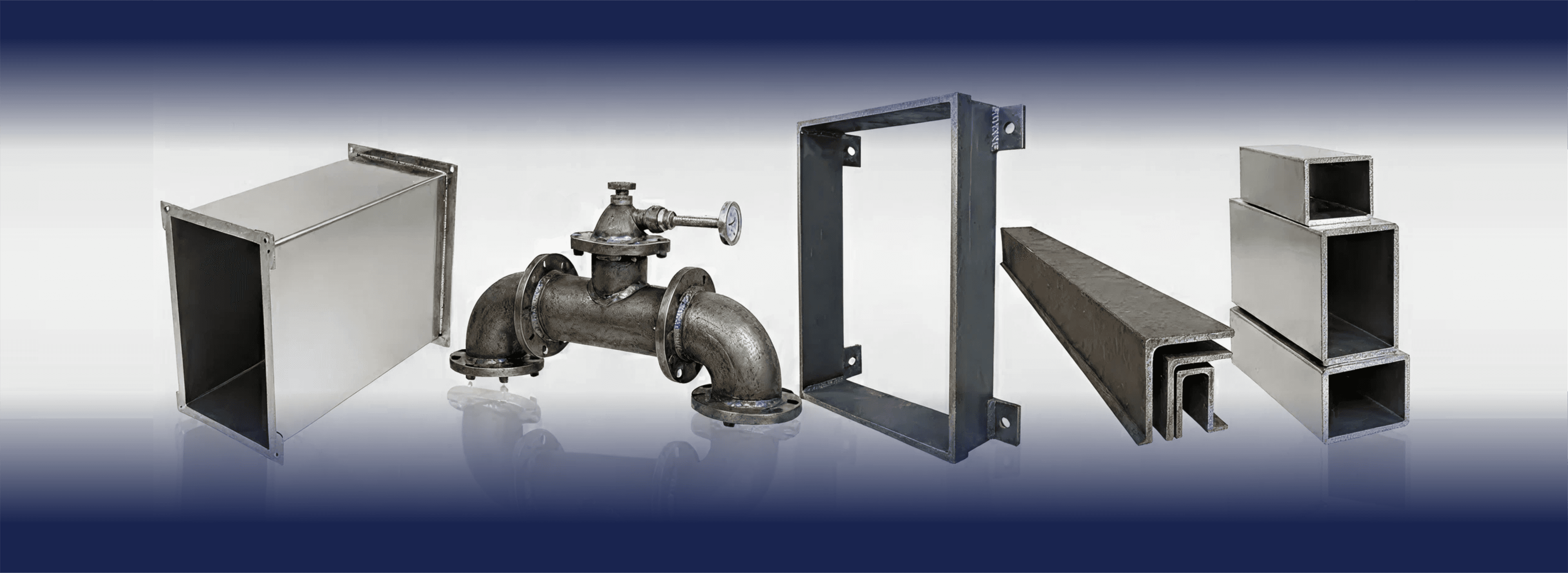
DUCT FITTINGS AND ACCESSORIES
Straight duct is the easy part. What actually decides whether a system fits, seals, and moves air is the fittings: the elbows, transitions, takeoffs, and dampers that get the duct around obstructions and tied into equipment.
This is a practical guide for mechanical contractors, engineers, and project teams specifying a duct package and deciding what to shop-fabricate versus cut in the field.
Published July 13, 2026 · JMC Fabrication
A duct run is only as good as the fittings that connect it. Straight sections are simple to build and forgiving to install. Fittings are where geometry gets hard, where leakage shows up, and where airflow gets helped or hurt. Get them right and the system balances, seals, and runs quiet. Get them wrong and you fight pressure drop, noise, and rework for the life of the building.
That is why a fabricator's real value lives in the fittings. Below is what JMC builds beyond straight duct, and why it pays to have those pieces made in the shop rather than pieced together on site.
Most of a duct package, by piece count and by difficulty, comes down to these:
- Elbows — Radius elbows turn the airflow with a smooth curve and the lowest pressure drop. Mitered elbows are used where space is tight, and turning vanes go inside them to guide the air and cut turbulence and noise. Which one you get depends on available room and how much pressure loss the design can absorb.
- Transitions and offsets — Transitions change the duct size or shape, round to rectangular or large to small, to match equipment connections and keep velocity in range. Offsets shift a run sideways to clear beams, pipe, and other trades. Gradual angles keep pressure drop down, so the shop builds them to the length the space allows.
- Takeoffs and tees — Takeoffs and tees branch air off the main trunk to each drop or diffuser. The branch angle and the collar detail set how evenly the system distributes air, which is why they are built to the layout instead of hacked in on the trunk.
- End caps and closures — End caps and blank-offs terminate a run cleanly and hold pressure. Simple pieces, but they have to seal, and a shop-built cap seals better than a field-formed one.
- Access doors — Access doors let crews reach dampers, coils, and controls for cleaning and service. They are framed and gasketed in the shop so they close tight and do not become a leak point later.
- Damper and equipment connections — Fittings that tie duct into dampers, fans, coils, and air handlers have to match the equipment's flanges and clearances exactly. These are built to submittal dimensions so the connection lands square and seals the first time.
The same fitting made in a shop and made on a ladder are not the same part:
- Fit: shop tools and layout hold dimensions and angles that hand-cutting cannot match, so pieces land square and connect clean
- Sealing: seams and joints are formed and sealed under controlled conditions, which cuts leakage and helps the system pass its pressure test
- Airflow: consistent radius elbows, proper turning vanes, and gradual transitions keep pressure drop and noise down across the whole run
- Consistency: repeatable parts mean the twentieth fitting matches the first, so a big package installs predictably
- Field time: crews assemble finished fittings instead of fabricating them in place, which is faster, cleaner, and safer
Straight duct is quick. Fittings are where the shop hours go, and the more complex the fitting, the more time it takes to lay out, form, weld or seam, and seal. A run of standard radius elbows moves fast. Custom transitions, tight offsets around structure, vaned mitered elbows, and equipment connections built to submittal dimensions all take longer, especially in stainless or heavier carbon steel.
The practical takeaway when you build a schedule: count your fittings, not just your linear feet. A package that is heavy on custom fittings needs more lead time than the duct footage alone suggests. Getting dimensioned drawings and equipment submittals to the shop early is the single best way to protect the delivery date.
JMC Fabrication is a Gulf Coast commercial and industrial metal fabricator based in Pascagoula, Mississippi, serving Mobile, New Orleans, and the Mississippi Gulf Coast. We build SMACNA duct and its full range of fittings and accessories in carbon steel, stainless, and galvanized, cut and sealed in the shop so they land right on site.
Send us the mechanical drawings and equipment submittals, and we will fabricate the elbows, transitions, takeoffs, dampers, and connections your system needs, built to spec and ready to install.
This article supports the following JMC capabilities: