
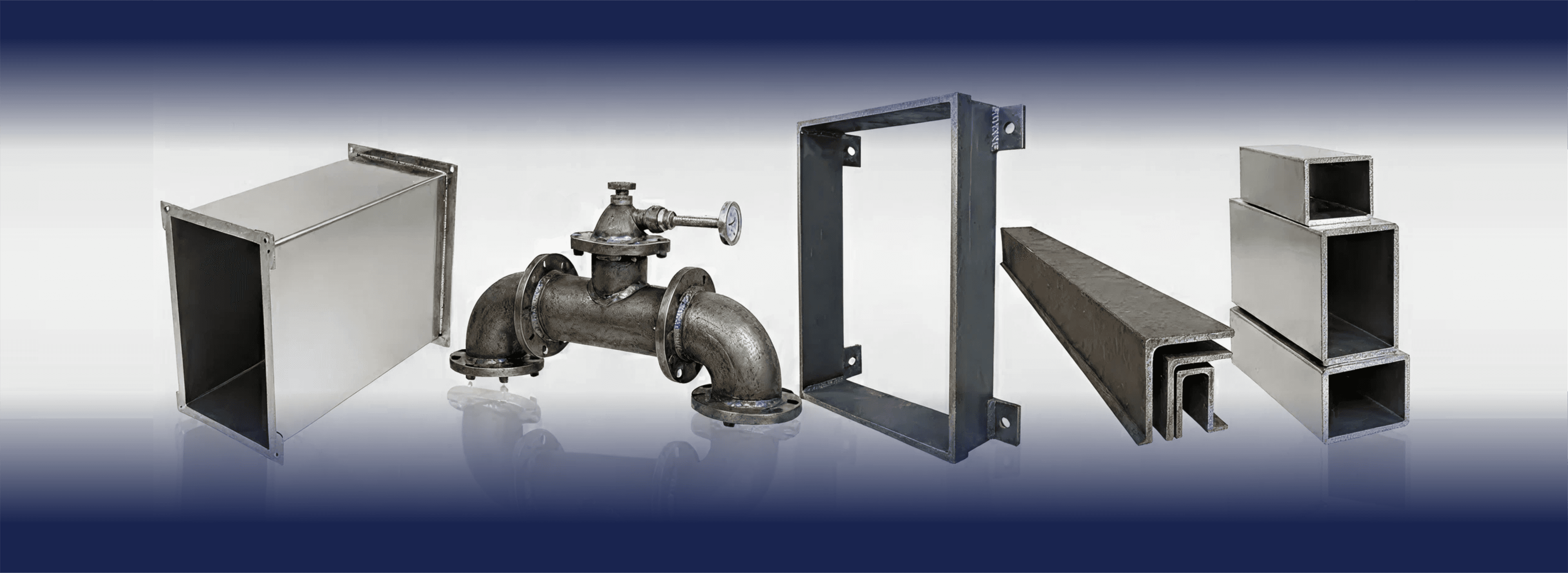
COMMERCIAL DUCT GAUGE AND STATIC PRESSURE
The short answer: duct gauge is not a single number you pick, it falls out of two inputs together, the largest dimension of the duct and its static pressure class. SMACNA construction standards pair those two to give you the minimum gauge, reinforcement spacing, and sealing the duct needs.
Here is how mechanical contractors and engineers can read that relationship, why pressure class is the driver, and how getting the gauge right keeps a job both compliant and on budget.
Published July 13, 2026 · JMC Fabrication
Gauge is a function of two things at once: how big the duct is and how hard the air is pushing on it. A wide, flat side of duct wants to bow and drum under pressure, so the bigger the dimension and the higher the static pressure, the heavier the metal and the tighter the reinforcement have to be.
SMACNA's duct construction standards turn that into a lookup. You find your largest duct dimension, cross it against the pressure class the system is designed for, and the standard gives you a minimum gauge along with the reinforcement type and spacing that go with it. Gauge, reinforcement, and joint construction are a set, not separate choices.
Static pressure is the load the duct wall lives under. Pressure class is simply the design pressure the system is built to hold, and it is the value that decides how much that wall has to resist deflection and leakage.
Raise the pressure class and three things move together. The wall needs more stiffness, which means heavier gauge or closer reinforcement. Seams and joints see more force, so the sealing requirement gets stricter. And leakage matters more, because the same crack leaks more air at higher pressure. That is why pressure class, not duct size alone, sets the tone for the whole build.
A few common commercial conditions push a system into a higher pressure class:
- Supply upstream of the terminal boxes — Medium-pressure supply feeding VAV boxes runs at a higher class than the low-pressure duct downstream of them.
- Long runs and high external static — Big buildings with long duct paths and heavy filtration need more fan pressure, and the duct has to be classed to match.
- High-velocity design — Moving more air through smaller duct raises velocity and the static pressure the walls have to hold.
- Negative-pressure returns and exhaust — Duct on the suction side has to resist collapse, so it carries its own pressure class and sealing rules.
Once the class is fixed, it cascades through the build:
- Minimum sheet metal gauge for each duct dimension
- Reinforcement type and how far apart it sits
- Joint and seam construction that can hold the load
- Sealing class, meaning how much of the duct has to be sealed against leakage
- How the finished duct is leak-tested when the spec calls for it
Getting the gauge right is a money question as much as a code question. Overbuild it and you pay for heavier steel, more reinforcement, and more labor than the system will ever need. Underbuild it and you get duct that bows, drums, leaks, and fails inspection, which costs far more to tear out and redo.
The clean answer is to build to the pressure class the engineer specified, no lighter and no heavier, and to fabricate the reinforcement and sealing that go with it. That is where shop fabrication earns its keep, because gauge, reinforcement, and sealing come out consistent instead of being sorted out in the field.
JMC Fabrication is a Gulf Coast commercial and industrial metal fabricator based in Pascagoula, Mississippi, serving Mobile, New Orleans, and the Mississippi Gulf Coast. We fabricate SMACNA duct in galvanized, carbon, and stainless steel, matching gauge, reinforcement, and sealing to the pressure class on your drawings.
Send us the mechanical spec and pressure classes, and we will build duct that meets the standard without carrying weight the job does not need.
This article supports the following JMC capabilities: