
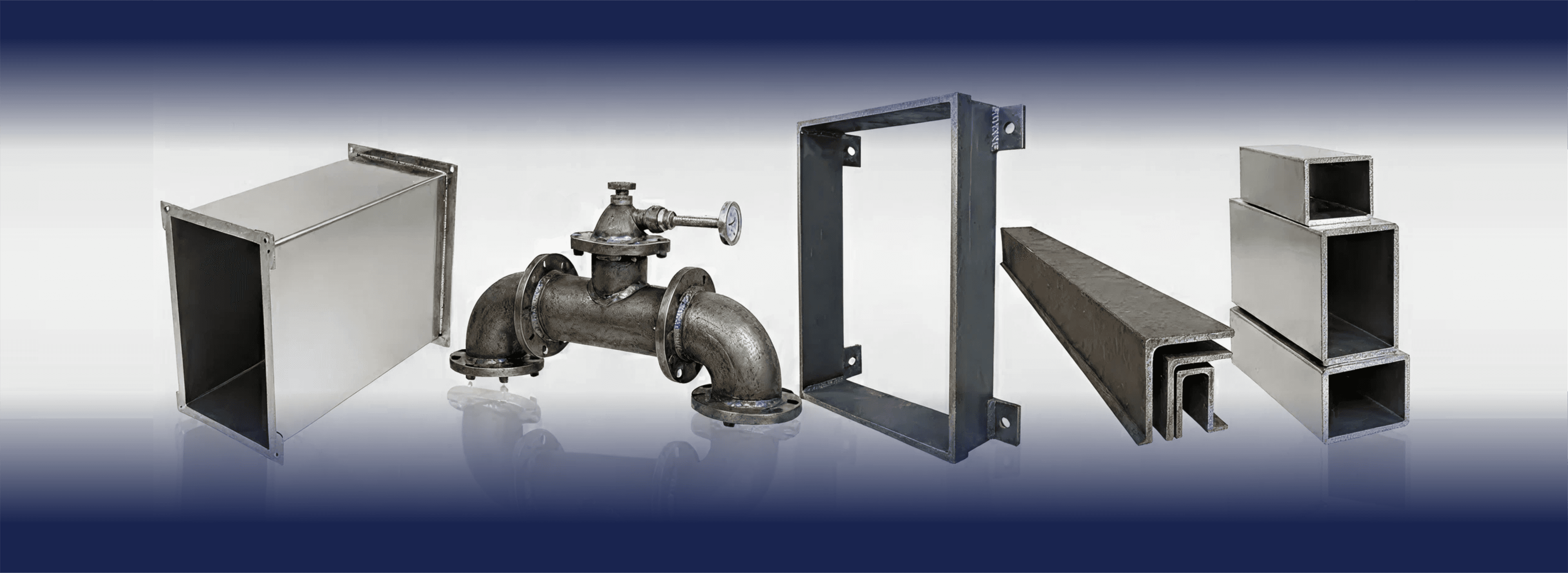
HOW TO SPEC A COMMERCIAL DUCT PACKAGE
A duct fabricator can only quote and build to what you give us. The tighter your spec, the tighter the price, the schedule, and the fit in the field. The gaps are where rework, RFIs, and slipped dates come from.
This is a practical checklist for mechanical contractors, engineers, and project teams putting a commercial duct package out for fabrication.
Published July 13, 2026 · JMC Fabrication
A complete duct spec answers six things: what the drawings and schedules call for, the material and gauge, the pressure and seal class, the liner or insulation, the finish, and how the duct connects and hangs. Add delivery sequencing and a real lead time and you have a package we can price and build without guessing.
When any of those is missing, we either quote conservatively to cover the unknown or stop and ask. Both cost you money and time. A clean spec removes that friction on day one.
To quote and build accurately, we need each of these in writing:
- Approved drawings and schedules — Current, coordinated mechanical drawings with duct sizes, routing, and the equipment schedule they tie to. Mark the revision so we build the right version, not a superseded one.
- Material and gauge — Galvanized, carbon, or stainless steel, and the gauge for each duct size. If you want us to hold to a SMACNA table rather than a fixed gauge, say so and name the standard.
- Pressure and seal class — The static pressure class for each system and the seal class that goes with it. This drives reinforcement, joint type, and how we seal, so it changes both cost and labor.
- Liner, insulation, and acoustics — Whether runs are single-wall with external wrap, internally lined, or double-wall, plus thickness and any acoustic target. Note where the airstream is corrosive or needs washdown.
- Connections and hangers — The joint and connection system, flange type, and any hanger or support requirements you want fabricated in rather than fielded. Call out transitions, access doors, and tie-ins to equipment.
- Delivery sequencing and lead time — The order you need duct on site, the required dates, and site access limits. Tell us what ships first so we build to your install sequence, not just to the takeoff.
These three set the backbone of the package:
- Material by system: galvanized for standard commercial supply and return, carbon or stainless where the application demands it
- Gauge tied to size and pressure, either called out directly or referenced to a SMACNA construction standard
- A stated static pressure class per system, positive and negative where they differ
- A seal class that matches the pressure class, since higher pressure and tighter leakage limits add reinforcement and sealing labor
- Any project leakage requirement, so we build and seal to hit it rather than a general standard
Where the duct runs decides what goes on and around it:
- Single-wall with field-applied external wrap where appearance and durability are not concerns
- Internal liner or shop-built double-wall where the duct is exposed, needs acoustic control, or has to stand up to airflow and cleaning
- Insulation thickness set by the thermal or acoustic target, not left open
- Condensation control called out for cold-supply and humid Gulf Coast runs so the duct does not sweat, corrode, or drip
- Finish requirements for exposed duct, including paint or primer, so it does not become a field add later
Every open item in a spec becomes a decision made without you. A missing gauge gets quoted heavy. An unstated seal class gets built to a general standard that may not pass your test. A liner assumption that is wrong gets torn out and redone. Each of those is rework, and rework on a duct package is rarely cheap.
The bigger cost is time. An incomplete spec turns into a string of RFIs, and every RFI is a pause in fabrication while the answer comes back. On a sequenced install, a few of those in the wrong week is a schedule slip that ripples into the rest of the trade work. A spec that answers the questions up front keeps duct moving off the floor and onto the truck on schedule.
JMC Fabrication is a Gulf Coast commercial and industrial metal fabricator based in Pascagoula, Mississippi, serving Mobile, New Orleans, and the Mississippi Gulf Coast. We build SMACNA duct in carbon, stainless, and galvanized steel, and we would rather answer your spec questions before we quote than after we cut metal.
Send us the mechanical spec, the duct drawings, and your delivery sequence, and we will come back with a quote built to what the job actually needs. If something is missing, we will tell you exactly what we need to firm it up.
This article supports the following JMC capabilities: