
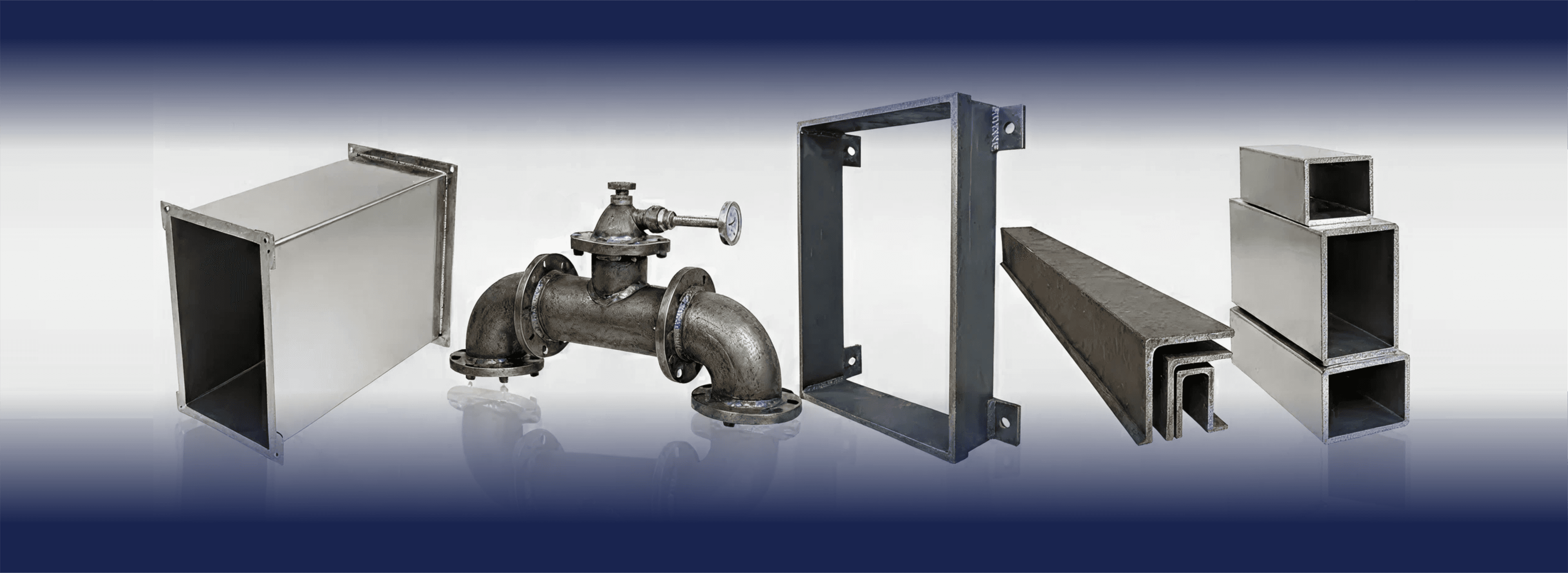
MARINE AND SHIPBOARD HVAC DUCT FABRICATION
Shipboard HVAC duct looks like commercial duct on paper, but it lives in a completely different world: salt air, tight machinery spaces, constant vibration, and a shipyard schedule that does not wait. Building it like a commercial job is how problems start.
This is a guide for shipyards, marine mechanical contractors, and engineers on what actually changes when duct goes to sea, and why it pays to fabricate with marine work in mind from the first cut.
Published July 13, 2026 · JMC Fabrication
The short answer: everything gets harder. A commercial building duct run sits in conditioned space, has room to route around obstacles, and rarely moves. Shipboard duct has to survive salt exposure, fit into spaces measured in inches, ride out constant vibration, and meet joining and structural rules that building codes never touch.
Material choice, weight, attachment, and welding all shift as a result. Get any one of them wrong and the duct either corrodes early, does not fit, works loose at sea, or fails an inspection that stalls the whole vessel.
Four constraints separate marine duct from anything built for a building:
- Corrosion and salt exposure — Salt air and washdown attack ordinary galvanized duct fast. Marine work often calls for stainless or heavier corrosion protection, and the material has to be matched to where the duct runs, from weather-exposed intakes to interior accommodation spaces.
- Weight and space — Every pound and every inch is accounted for on a vessel. Duct has to thread through crowded machinery spaces and tight accommodation overheads, which drives compact routing, careful transitions, and gauge choices that hold strength without adding needless weight.
- Vibration and structural attachment — A ship is a moving, vibrating structure. Hangers, supports, and penetrations have to be engineered so the duct does not fatigue, rattle, or break loose underway, and so it plays well with the surrounding steel structure.
- Welding and joining — Marine duct and connected piping frequently require welded joints held to standards that go well beyond commercial sheet metal practice. That means qualified welders and procedures, not just field crimps and sealant.
On land you can wrap a duct or repaint it. At sea, replacing corroded duct in a packed machinery space is a serious job, so the material has to be right the first time. Stainless, galvanized, and carbon steel each have a place depending on exposure, weight, and the classification-society or Navy requirements that apply to the vessel.
JMC works across stainless, carbon, and galvanized steel, so the material follows the requirement instead of forcing the requirement to follow whatever is on the rack.
JMC fabricates marine HVAC duct with the constraints above built in from the start:
- SMACNA duct fabrication for the ductwork itself
- Spooled piping fabrication where duct ties into connected systems
- Stainless, carbon, and galvanized steel matched to exposure and weight targets
- AWS and NAVSEA welding capability for joints that have to meet marine standards
- Shop-built, sealed assemblies that arrive ready to set, not finish in place
JMC is based in Pascagoula, Mississippi, in the heart of Gulf Coast shipbuilding, and marine work is a core part of what we do. We serve Mobile, New Orleans, and the Mississippi Gulf Coast, so shop-built duct does not cross the country to reach the yard.
That proximity matters when a shipyard schedule tightens. Being close to the waterfront means we can coordinate on delivery windows, adjust as the build sequence shifts, and keep fabrication moving in step with the vessel rather than against it.
Marine duct rarely gets built in a vacuum. It has to land when the compartment is ready, ahead of the systems that follow it, and without holding up the trades working around it. That takes a fabricator who reads the build sequence and plans deliveries to it.
Send us the drawings and the schedule. We will fabricate the duct and connected piping to spec, hold the material and welding standards the vessel requires, and time delivery to the yard.
This article supports the following JMC capabilities: