
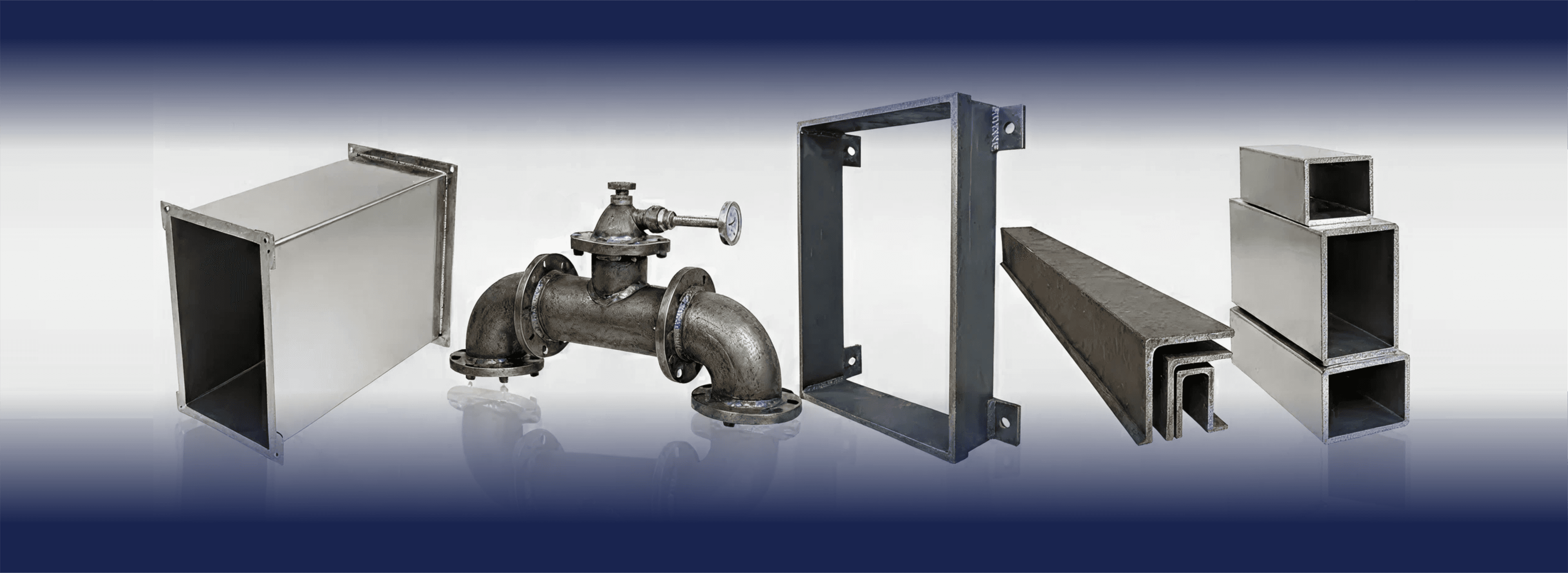
PUMP SKID FABRICATION: WHAT'S INCLUDED AND HOW IT'S BUILT
A pump skid is a complete pumping system, pump, motor, baseplate, piping, valves, and instrumentation, assembled and tested as one unit before it ever reaches the job site. Instead of a contractor mounting and piping a pump in the field, a fabrication shop builds the whole package, ships it as a unit, and the field crew sets it, bolts it down, and hooks up the connections.
For projects with multiple pumps, tight schedules, or process piping that needs to be right the first time, skid-mounted packages cut field labor and reduce the chances of a fit-up problem showing up after the concrete is poured. Here's what actually goes into one and how the fabrication process works.
Published August 19, 2026 · JMC Fabrication
A pump skid starts with a structural steel baseplate or subbase, sized and reinforced to carry the pump, motor, and piping loads without flexing under vibration. From there, the scope typically includes the pump and driver mounting, suction and discharge piping, isolation and check valves, pressure gauges and instrumentation taps, and a coating or finish system appropriate to the install environment.
Depending on the application, a skid package can also include a control panel, local disconnect, drip pan or containment, and lifting lugs sized for the finished weight of the assembly. The goal is a package that arrives complete: set it, anchor it, connect the inlet and outlet, land the electrical, and start it up.
- Structural baseplate or subbase, sized for the pump/motor combination and anchor bolt pattern
- Pump and motor mounting, aligned and doweled per the manufacturer's tolerance
- Suction and discharge piping, sized and routed per the process spec
- Isolation valves, check valves, and any required bypass piping
- Pressure gauges, gauge isolation valves, and instrumentation taps
- Coating or finish system, epoxy, galvanizing, or paint depending on the environment
- Lifting lugs and, where specified, a drip pan or secondary containment
Pump skid fabrication starts with the drawings, either customer-supplied or developed in-house from a pump curve, a P&ID, and a footprint. JMC's engineering team works in CAD/CAM and Revit BIM to lay out the baseplate, confirm pump and motor mounting dimensions against the manufacturer's certified drawing, and route piping so it doesn't interfere with maintenance access, coupling guards, or lifting points.
Once the design is confirmed, the baseplate and structural steel are cut and welded in the shop, piping is fabricated and fit up dry before final welding, and the pump and motor are set and aligned. Welding on the skid structure and piping is performed by AWS certified welders, and NDE is applied per the project specification where required.
Before it ships, the completed skid gets a dimensional check against the drawing, a fit-up and alignment verification, and, where the scope calls for it, a hydrostatic or pneumatic test on the piping before paint or coating goes on.
- One lift instead of a sequence of trades — A pre-built skid goes in as a single lift. That replaces a sequence of separate trades, structural, mechanical, piping, on site, each waiting on the one before it.
- Alignment happens in the shop, not on a slab — Pump-to-motor alignment done on a shop baseplate, in a controlled environment with the right tools, is more reliable than alignment attempted after a skid is already anchored to a foundation with limited access.
- Piping is pressure tested before it's buried in insulation or a pipe chase — Testing the skid's piping in the shop catches problems while they're still easy to fix, before the package is set, insulated, and tied into permanent plant piping.
- Multiple identical skids come out consistent — For projects specifying more than one pump package, shop fabrication produces units that match. Field-built duplicates rarely come out identical.
The steel skid base is the part of the design people underestimate. It isn't just something to bolt the pump to. It has to hold alignment, survive a lift, and fit the foundation it lands on.
- Stiffness comes first — The base frame is usually structural channel or wide-flange beam with cross members under the pump and motor. If the frame flexes when it's lifted, shipped, or anchored down, the shaft alignment set in the shop won't survive. A base that's sized only for weight, not for stiffness, is the most common reason a skid needs realigning on site.
- Flat, coplanar mounting pads — Pump and motor feet need to sit on pads that are flat and in the same plane, either machined after welding or built up and shimmed. Jack bolts at the motor make final alignment adjustable without prying on the equipment.
- Drip rim and drain — Most process and utility skids get a raised drip rim or drain pan with a sloped deck and a drain connection, so seal leakage and washdown water go somewhere planned instead of onto the slab.
- Lifting lugs sized to the real center of gravity — Lugs are placed and sized for the fully dressed skid weight, pump, motor, piping, and fluid-free valves included, with the center of gravity accounted for so the skid hangs level on the crane.
- Anchor and grout details — Anchor bolt holes are laid out to match the foundation drawing. If the base will be grouted, it needs grout fill holes and vent holes so the grout actually fills the frame instead of trapping air under it.
To get an accurate quote, a fabricator needs the following up front:
- Pump make, model, and certified dimensional drawing, or the pump curve and duty point if the pump hasn't been selected yet
- Motor frame size and mounting details
- Suction and discharge piping size, material, and pressure class
- Site footprint constraints, if the skid has to fit an existing pad or equipment room
- Instrumentation and control requirements, gauges, transmitters, local panel, or tie-in to an existing control system
- Coating or finish requirements for the install environment
- Applicable codes or standards, ASME B31.3 for process piping, NAVSEA for marine, or others
A fabricated pump skid moves the hardest parts of the job, alignment, piping fit-up, pressure testing, into a shop where they're easier to get right and easier to fix if something's off. JMC builds pump skids in-house from engineering through delivery, working from customer drawings or building the design from a pump curve and a footprint, out of a 50,000 sq ft shop in Pascagoula, MS.
If you're not sure whether your pump package should be skid-mounted or field-assembled, send over the pump data and the site constraints. That's usually enough to give a straight answer.
This article supports the following JMC capabilities: