
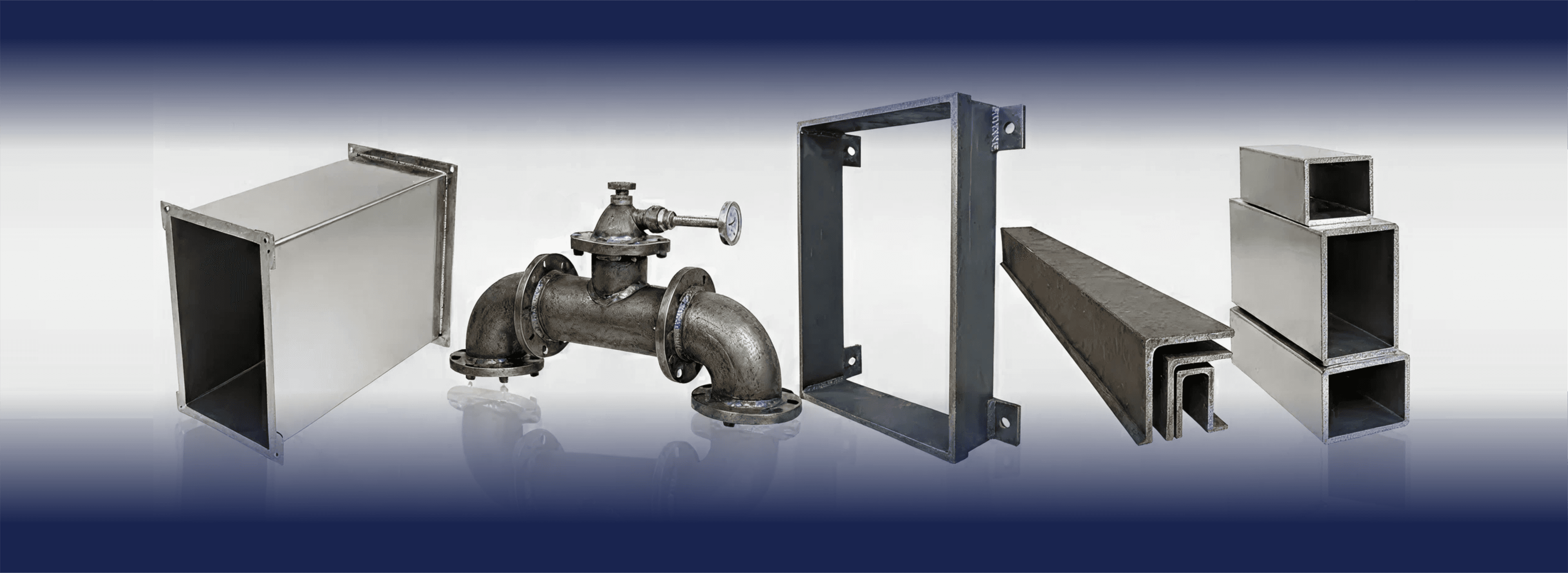
SPECIALTY WELDMENTS: WHAT THEY ARE AND WHEN YOU NEED CUSTOM FABRICATION
A specialty weldment is a fabricated assembly built for a specific, non-standard application, a bracket, frame, mount, or structural component that doesn't exist as a catalog part because the application doesn't fit a catalog part. If you can order it from a supplier's parts list, it's not a specialty weldment. If it has to be designed and built to fit a specific piece of equipment, a specific space, or a specific load condition, it is.
Most projects have at least a few of these: a mounting frame for a piece of equipment that was never designed with mounting in mind, a bracket that has to clear an obstruction no standard part accounts for, a structural component that ties two different systems together. Here's how to think about when you need one and what goes into building it.
Published August 19, 2026 · JMC Fabrication
Every weldment is a fabricated assembly of steel parts joined by welding. What makes one a specialty weldment is that it's a one-off, or a small run, designed for a specific application rather than pulled from a standard product line. That could mean a custom equipment mount that has to match bolt patterns on both a piece of machinery and an existing foundation, a structural bracket that has to carry an odd load path around an obstruction, or an assembly that combines materials or geometries a standard part doesn't cover.
The defining trait isn't complexity, some specialty weldments are simple, it's that the part has to be engineered for the specific application rather than selected from a catalog.
- Nothing in a supplier catalog fits — If you've checked standard product lines and nothing matches the bolt pattern, clearance, or load requirement, that's the clearest signal. Forcing a standard part to work with shims, field modification, or workarounds usually costs more in labor and risk than fabricating the right part.
- Two systems have to tie together and neither was designed for the other — Retrofits and equipment upgrades often need a transition piece, mount, or bracket that connects new equipment to an existing structure that was never designed to receive it.
- The load path is non-standard — Odd angles, offset loads, or equipment that has to be supported from an unusual point all push a project out of catalog-part territory and into custom design.
- Space or access constraints rule out standard geometry — Confined spaces, tight equipment rooms, and retrofit conditions frequently require a part shaped to fit the space rather than the other way around.
Specialty weldment work starts with the same question every custom fabrication project starts with: what does this part actually need to do, and what does it need to fit? JMC can work from customer-supplied drawings, or build the design from scratch using CAD/CAM drafting and Revit BIM modeling when the part needs to be engineered from a field condition or an equipment spec sheet rather than an existing drawing.
Material selection depends on the application, carbon steel for most structural brackets and mounts, stainless steel where the environment is corrosive or the application is sanitary, and other materials as the job requires. Welding on specialty weldments is performed by AWS certified welders, with NAVSEA certification available for marine work, and dimensional and fit-up verification happens before the part ships, since a specialty part that doesn't fit its one specific application has no other use.
Because these are one-off or low-volume parts, the RFI and fabricability review step matters more than it does on standard products. Catching a clearance problem or a load path issue on the drawing is far cheaper than catching it after the part is built.
For an accurate quote on a custom weldment, provide:
- A drawing or sketch of the part, or the equipment spec sheet and field dimensions if no drawing exists yet
- What the part connects to on both ends, bolt patterns, mounting points, or interface dimensions
- Load requirements, if known, static weight, dynamic loads, or vibration considerations
- Material preference or application environment, so the fabricator can recommend material if you haven't specified one
- Quantity, one-off or a small production run
- Finish requirements, paint, galvanizing, or bare metal
Specialty weldments are where custom fabrication earns its name, parts that exist because the application demanded them, not because they were on a shelf. JMC builds specialty weldments as part of its custom metal fabrication scope, from concept through delivery, AWS and NAVSEA certified, out of a 50,000 sq ft shop in Pascagoula, MS.
If you've got a part that doesn't exist in a catalog, send what you have, a sketch, a spec sheet, field dimensions, and JMC's engineering team can take it from there.
This article supports the following JMC capabilities: