
WALL AND DECK PENETRATION FABRICATION FOR MARINE AND INDUSTRIAL PROJECTS
Every pipe, cable, or duct that has to cross a bulkhead, deck, or fire-rated wall needs a penetration, a fabricated sleeve or fitting that lets the service pass through while preserving the structural, watertight, or fire-rated integrity of what it's passing through. On a marine vessel or an industrial facility, that's not a minor detail. A poorly fitted penetration is a leak path, a fire-rating failure, or a rework item discovered after the wall is already closed up.
Penetrations are a small part of most projects by dollar value and a large part by consequence if they're wrong. Here's what goes into fabricating them correctly.
Published August 19, 2026 · JMC Fabrication
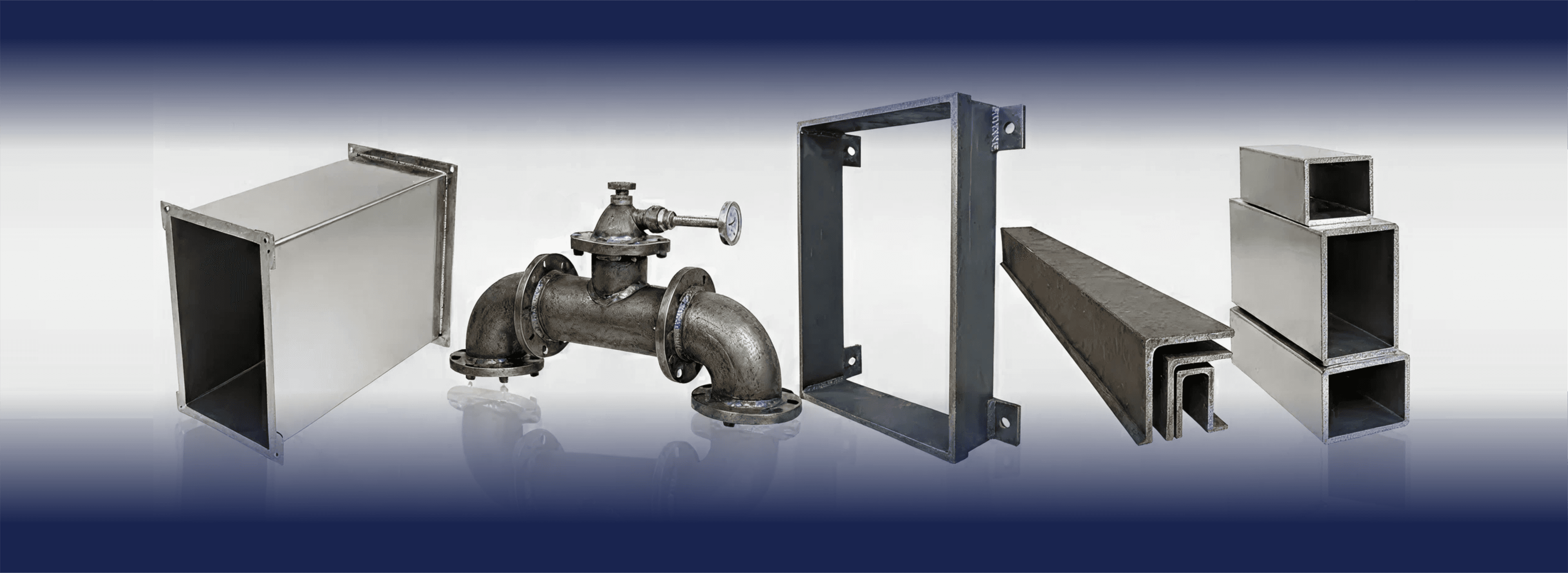
A penetration is any fabricated opening, sleeve, or collar built to let a pipe, cable, duct, or structural member pass through a bulkhead, deck, hull, or wall. On a marine vessel that might be a watertight pipe penetration through a bulkhead below the waterline. In an industrial plant it might be a fire-rated sleeve through a rated wall, or a structural penetration through a floor deck for a chase or riser.
The fabrication scope usually includes the sleeve itself, any reinforcing collar or doubler plate needed to restore structural strength around the opening, and the seal or gasket detail that maintains the wall or bulkhead's rating, watertight, fire-rated, or pressure-rated, once the service is installed through it.
- Watertight integrity is binary — On a marine bulkhead below the waterline, a penetration either maintains watertight integrity or it doesn't. There's no partial credit for a sleeve that's close but not welded correctly to the plate it's passing through.
- Fire rating depends on the whole assembly, not just the wall — A fire-rated wall with an improperly sealed penetration through it isn't a fire-rated wall anymore. The penetration detail has to match the rating of the wall it's cut into.
- Structural openings need reinforcement, not just a hole — Cutting an opening in a load-bearing deck or bulkhead removes material that was doing structural work. A properly fabricated penetration includes the doubler plate or reinforcing ring that puts that strength back.
- Field modifications to a bad penetration are expensive — A sleeve that's the wrong size, in the wrong location, or missing its reinforcement is a field problem discovered late, usually after the surrounding structure is already in place and hard to access.
Penetration fabrication starts with the same engineering step as any custom metalwork: confirming the exact location, size, and orientation against the structural drawing or as-built condition, and identifying what's passing through, pipe diameter and material, cable tray width, duct dimensions, so the sleeve is sized correctly with the right clearance.
For structural penetrations, JMC's engineering team calculates or confirms the reinforcement needed around the opening, a doubler plate or reinforcing ring, so the finished assembly restores the strength removed by the cut. Material selection follows the parent structure: carbon steel for most structural work, stainless where the environment is corrosive or sanitary, and material certifications are available when the project requires traceability.
Welding is performed by AWS certified welders, and for marine work, penetrations that affect watertight integrity are built to NAVSEA requirements. Fit-up is verified before the piece ships, since a penetration that doesn't match the actual field opening is a problem discovered at the worst possible time.
For an accurate quote and a penetration that fits the first time, provide:
- The structural drawing or as-built condition showing wall/deck/bulkhead thickness and material
- What's passing through, pipe size and material, cable tray dimensions, or duct size
- The rating that has to be maintained, watertight, fire-rated, or pressure-rated
- Whether reinforcement (doubler plate, reinforcing ring) is required or has already been engineered
- Applicable code or standard, NAVSEA for marine watertight penetrations, local fire code for rated wall penetrations
- Field measurements if the opening location isn't fully dimensioned on the drawing
Penetrations rarely get the attention the pump skid or the piping system gets, right up until one doesn't fit or doesn't hold its rating. JMC fabricates structural and pipe penetrations as part of its custom metal fabrication scope, AWS and NAVSEA certified, out of a 50,000 sq ft shop in Pascagoula, MS, working from customer drawings or field measurements.
If you've got a penetration schedule that needs fabricating, send the structural drawings and the rating requirements. That's enough to start.
This article supports the following JMC capabilities: